Book Review

Down with the System: A Memoir (Of Sorts)

by Serj Tankian

Hachette Books, 2024

ISBN: 978-0-306-83192-8   hardcover   $30.00

I remember clearly the first time I heard System Of A Down. In 2019, not too long after my hiatus from music ended (read that story here), I was driving along a country road on my way home from my office with the radio cranked up loud on SiriusXM’s Octane rock music channel. The DJ was talking about System. I wasn’t paying attention—I’d never heard of them.
“Disorder! Disorder! Disor-or-or-der!” the vocalist screams.

What the hell is this?

The song was “Toxicity”, and boy, did it grab me—fortunately, I was still able to find my way home despite being enthralled by the song. I also heard “Chop Suey” and, my favorite, “Aerials”, over the years, but the band’s been quiet since System’s last two albums, Mesmerize and Hypnotize, were released back in 2005. I confess System dropped off my radar until this spring, when my daughter sent me a link to an NPR.org story about Serj Tankian’s memoir. Book in hand, I dove into System’s discography on Spotify, listening to songs and albums as Tankian discussed them in his book.

Serj Tankian’s book, Down with the System: A Memoir (Of Sorts), is a great read. Do you have questions like: What do System’s crazy lyrics mean and where does their amazing  sound  come from?  What  makes  Serj Tankian tick? What does the name, System Of A Down, mean? Why isn’t the band touring and recording new music? And what does Armenia have to do with it all? Down with the System has some answers for you.

Tankian begins his story at its roots—his family’s life in Armenia, and their struggle and suffering at the time of the Genocide (dated at 1915-1917). They fled to Beirut,  Lebanon,  where  Tankian was born (1967), only to be uprooted once again by the Lebanese Civil War that began in 1975. “If you want to understand anything about me, my life, or even System Of A Down, you need to understand the Armenian Genocide,” writes Tankian. And to help with that, he gives a good dose of the essential history.

Immigration to America had an immense impact on Tankian. In so many immigrant families, children effectively live in two worlds—the school world of American culture and language, and the “old world” of their parents whose limited English and unfamiliarity with American ways can put them at risk of unfair and potentially costly situations. 

Tankian’s family was no different. They faced the legal ramifications of a business decision his father made, and, during his high school and college years, it fell to Tankian to help his parents deal with the lawyers and the courts.Then, after college, he took a job in his uncle’s jewelry business. 

During that time, messing around with a keyboard was initially a stress reliever, but it evolved into to a hard-core romance with music. Seizing opportunities to make music, Tankian fell into a band that led to one of those innocuous-seeming, but ultimately life-changing meetings (think John Lennon’s first meeting with Paul McCartney): Tankian met Daron Malakian, an Armenian-American kid who “ate, drank and slept music.” When that first band faded away, Tankian and Malakian, their chemistry undeniable, started another band, Soil, a seminal effort that paved the way for System.

Tankian took all that legal and business experience gleaned while helping his family and created a successful software business to support his music. It gave him a steady income and eventually provided space to allow System to grow  musically while developing a crucial fan base. Ultimately, when music demanded more of his time than the business allowed, he sacrificed the business to focus full-time on music.

“[T]he only thing in my life that felt like it was  mine  was music,” Tankian writes. Life in Beirut with “bombs raining down” and his family’s experiences taught him that “[S]afety and financial security is a mirage. It can be taken away just like that … Music or art … felt more meaningful … Art … just is. … The way it makes me feel—or the way it makes someone else feel—is the whole fucking point.”

System’s music is “loud, heavy, political, artsy, and weird,” and the band’s tour with Slayer ahead of their first album release was “like going to rock ‘n’ roll boot camp” and a“real trial by fire.” But the lesson Tankian took was not what you might expect. “If there was one valuable lesson … it was this: don’t be neutral—it’s boring. … To me, that’s really the mandate for any kind of art. Don’t make neutral art and don’t make neutral music—that’s for elevators and malls. At the very least, make people feel something.”

Social and political commentary is integral to System’s identity. All of the band’s members are Armenian-Americans, and Tankian was first, and remains, an activist. “I made a promise to my grandfather that I’d keep telling [the] story [of his grandfather’s experience during the Genocide]… I also connected his struggle to a wider fight against injustice and inequality not just for Armenians but for everyone and everything. … You could say that activism has always been in my blood …”

Whether art should marry activism is subtext throughout  Tankian’s  memoir. While reading it, I was reminded of Picasso’s magnificent, horrific  painting,  Guernica, painted as an argument against war. Art can force us to look at truths we may prefer to avoid; we cannot look away. Tankian and System Of A Down draw us in with often insane lyrics and music that runs the gamut from folk melody to discordant noise. But when the last note fades, we’re left feeling—and thinking. 

Tankian’s fascinating book reveals him as a complex, inner-directed artist with an entrepreneurial enthusiasm and curiosity that animates his life beyond System. Some will follow the threads of Tankian’s  understatedly competitive relationship with Daron Malakian through the book, looking for reasons for the band’s silence. But creative alliances have their ups and downs (again, think Lennon and McCartney). That Tankian writes of System in the present tense throughout the book bodes well for the band’s future, though it will probably continue to be complicated. 
I highly recommend Down with the System

Skip Ticketmaster—Great Local Bands Rock Too!

There’s been a lot in the media lately about outrageous ticket prices for live music—the add-on fees exceeding the ticket price; Ticketmaster’s plan to float seat prices according to demand (euphemistically referred to as “dynamic pricing”) as is the norm with air travel prices (and why not—some tickets cost as much or more than air travel); and the debacle of Taylor Swift’s presale demand overwhelming Ticketmaster systems. All of this is merely capitalism at its best—it’s all about demand and market forces.

Those spectacular concerts and mega-shows, fees or no fees, cost significant dollars for a seat, and if you can afford the seat (or standing), you can probably also afford the $20 burger and $10 beverage, and don’t forget, there will be merch as well, making for a pretty expensive night. These shows are making somebody rich—probably the label—with a reasonable (we hope) percentage to the band and its songwriters. These are shows for bands that have arrived, bands with the clout to write their own tickets (pardon the pun).

But there’s more to the live music world than expensive flame-throwing spectacles. Elite artists, it’s safe to say, got their start somewhere else.

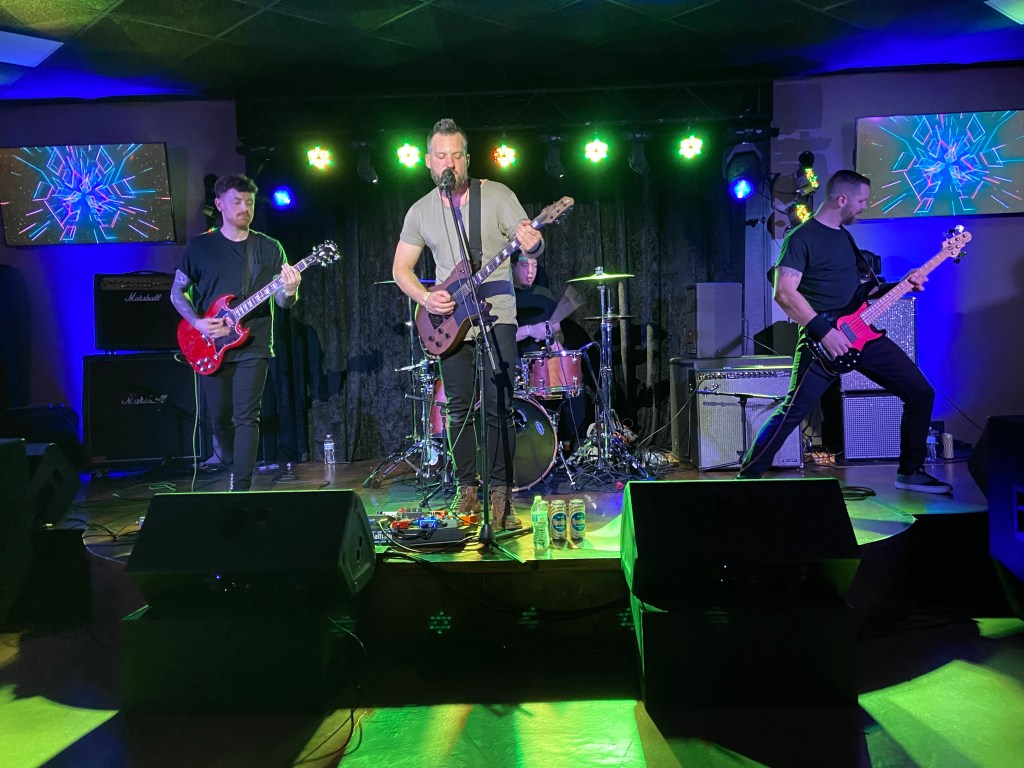
This was brought home to me recently at the Rivet Canteen and Assembly in Pottstown, Pennsylvania. I was happy to find that my plan to paint my daughter’s kitchen on a recent weekend coincided with an opportunity to support a local Pennsylvania band, Die Tired, whom I’d been following via Spotify and social media. My daughter had tagged me on one of their posts, I checked them out on Spotify, and told her, “We should go see these guys!”

The Rivet is located in a century-old downtown Pottstown building, with rustic styling to reflect the town’s industrial history. The venue presents both live music (their full schedule is here) and celebratory events, like wedding receptions and corporate parties. Their large room, called the Foundry (in honor of the region’s steel-making era), offers a good-sized stage, sound system and lighting, along with table seating for the audience. Die Tired was the headliner, with two other new-to-us bands on the program. All of the bands hailed from eastern Pennsylvania.

Arriving shortly after doors opened, we parked in the free lot out back and walked up to the entrance. From the street, with its big glass windows common once-upon-a-time along Main Streets everywhere, Rivet’s space looks like it might have once housed a department store. Inside, we were welcomed by a staffmember who invited us to pick a table in the Foundry room and shared menus from nearby brewpubs; she explained that we could just call them and order delivery right to the Rivet.

Choosing a table was a major decision: Do we sit really close to the action (about 15 feet in front of the drum kit) or less close, up in back (maybe 30 feet from the band) but in an elevated semicircular booth (very nice for a date night!).We opted for right in front of the drum kit.

As we sat there considering what food to order, two guys came over to chat. They revealed themselves to be with Die Tired. They’d seen my post wherein I tagged my daughter with her photographer handle, and we chatted awhile about bands she’s photographed.

Kristin went to fetch us a couple of beers—“Tripod” Belgian tripels—from the Rivet’s bar but brewed across the street at J. J. Ratigan’s. Then we began unpacking our just-delivered chili and loaded tater tots from Pottstown United Brewing Company.

Die Tired

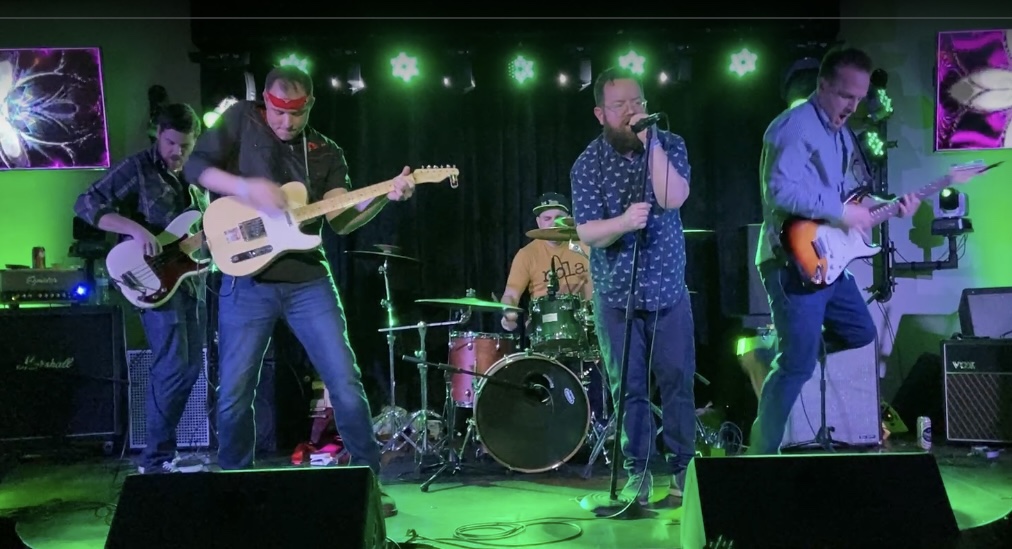
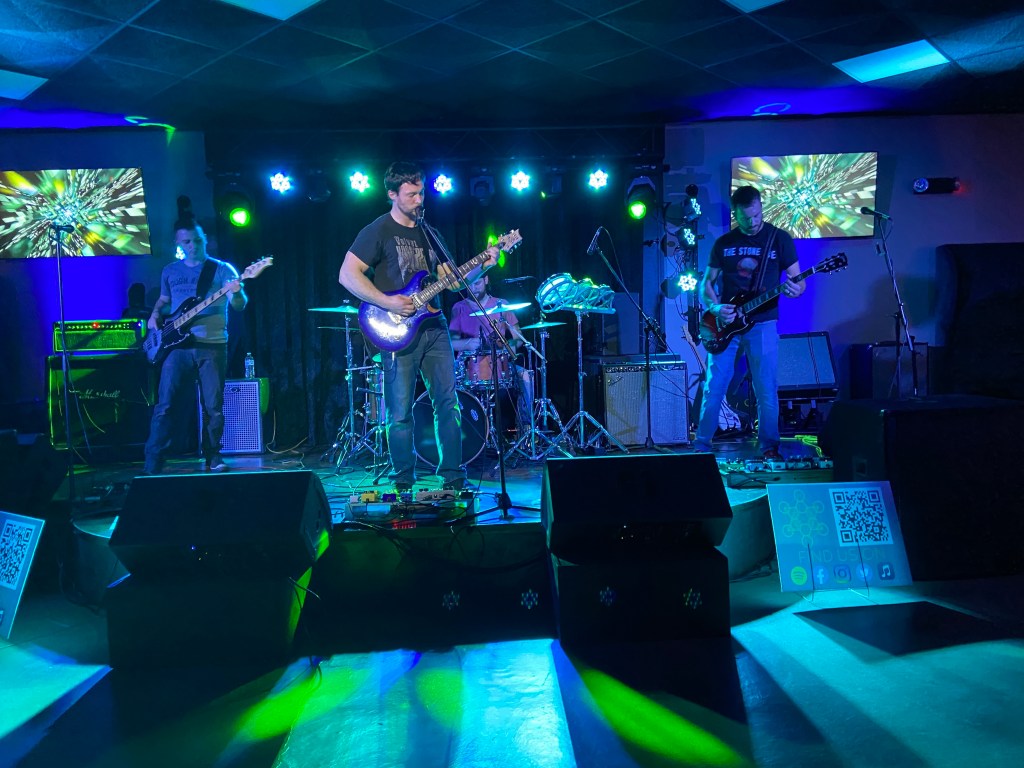
While we were digging into our tots, the opening band, The Tressels, came out, did a quick sound check, and then hurtled full-throttle into their set. These guys could play! I was even more astounded when their vocalist said this was their first show since 2016. They wrapped up about 45 minutes later, cleared their equipment, and the next band, Hannibal-HNBL, came out, channeling ‘70s prog rock that blew me away. Headliner Die Tired capped off the show with a great set that included their just-dropped-that-day single, “Better Off Alive”, as well as another recent single, “Play”. After their sets, at the merch table, I chatted with HNBL and Die Tired band members while adding to my tee shirt collection. And all this crazy good rock ‘n’ roll for only $12 at the door!

The Tressels
Hannibal – HNBL

I only wished the crowd had been bigger for these fantastic local bands.

These musicians haven’t given up their day jobs yet. Like the rest of us, they work all day, but then they go home to practice their music.  You cannot stand up in front of a crowd and be the evening’s rock star if you haven’t put in the work. For all the excitement and spectacle of a stadium show, the mega-bands on the program of such a show did not burst full-blown onto the world stage. They had to start by getting up the courage to show up in a small venue somewhere and take their chances with a live audience for a first time, and many more times thereafter. Artists practice in private but at some point, validation requires that they go out front and play.  And we should be there to support them when they do.

One of the catastrophes of the pandemic was the impact of lockdowns on these small local venues and the bands that depend on them. I would hazard a guess that those big arenas and stadiums did not suffer the pandemic to quite the same degree. 

Remember when we were unable to go to live performances? Tours were canceled, rescheduled, canceled, rescheduled and sometimes finally scratched entirely. The venues for these performances suffered the loss of income painfully, but not equally. The arenas and stadiums knew their bread-and-butter sports teams and elite bands—and their fans—would be back as soon as the pandemic eased. Small venues and local bands had no such assurance. Many small venues did not survive.

While stadium and arena shows do inject funds into their communities, small venues do so as well on a grassroots level. Like their bigger cousins, small venues pay taxes in their communities and provide employment for local people.

But small venues have another part to play. They offer entrée into the world of artistic performance for the local bands and artists who appear there. Small venues are the proving grounds for young or new artists, where they can cut their musical teeth, discover their fans, and advance their art.

Only in the small venue can you have that in-the-room feeling, the excitement of being part of something special, sharing the atmosphere with like-minded fans in support of a group of musicians who are trying to make a go of it. In the small venue, you can watch the guitarist’s hands on the instrument as you hear the notes reverberating in the room, you can make eye contact, and connect with the artist in a way that is impossible in a mega-venue (unless perhaps you’re down there on the floor at the barrier, but that’s a different experience entirely.)

Local music will likely never have the polish of those flame-throwing mega-bands with their decades playing together. Local music will always be a little rough around the edges. But what could be better than spending a few bucks in a local spot and discovering a bunch of hard-working musicians having a great time making music for you. After all, it was a small local venue—that repurposed warehouse cellar in Liverpool known as The Cavern—that gave the Beatles their start.

For a good discussion of the key part that small venues play in the music industry, check out this pertinent article from 2020.

Book Review

Bodies: Life and Death in Music

By Ian Winwood

London: Faber & Faber Ltd, 2022

ISBN: (e-book) 978-0-571-36420-6

We’ve all seen the headlines about rock musicians dying unexpectedly. All too often we learn in the follow-up that he or she died of causes related to substance abuse and/or mental health issues. Why does this happen again and again? In Bodies: Life and Death in Music, Ian Winwood attacks this question.

Winwood writes, “This is a book about. . . music, musicians, the industry, mental health, addiction, derangement, corrosive masculinity, monomania, overdoses, suicide and a hectare of early graves. . . . But in writing this story, I’ve come to regard artists as victims and survivors of circumstance. In pursuit of a living wage, musicians are required to work themselves into the ground.” At its base, he posits, music is a “proper job” that does not pay a proper wage.

Bodies serves up an indictment of the parasitic relationship between the music industry and those who would make a career in it and the substance abuse that fuels it. In this engrossing yet disturbing read, Winwood strives, he says, “to join the dots. . . . There is something systemically broken in the world of music. It’s making people ill.”

A British music journalist whose career has included more than twenty years writing for Kerrang! and major UK newspapers, Winwood has interviewed members of Metallica, Green Day, Nine Inch Nails, Pearl Jam, Guns N’ Roses, Mötley Crüe, Foo Fighters, and the Smashing Pumpkins, plus many more whose names are yet to—or may never—become household words. He has lived a rock-star lifestyle, giving him keen insight into how rock stars and wannabes survive. . . or not. Winwood has watched musicians fly to the heights, but he has also seen them crash and burn. And he has been to the depths himself as well.

The book opens with Winwood’s 2003, world-exclusive interview with Metallica following a six-year break during which the band had issued no new music. It’s “my job to discover exactly what has been furring the arteries of one of the most popular bands on the planet,” Winwood says, and the burning question, of course, is why the silence? What went wrong? What went wrong was alcohol.

Metallica was one of the first bands Winwood saw live, at age 15, following their release of Master of Puppets. To support his music habit, Winwood worked two jobs, including one in a bookshop, where he discovered Kerrang! When, later, his mother asked him what he might do with his life after school, he replied, “I want to write for Kerrang!” With his mom’s “I don’t see why not” response, he determined to make it happen, attending a university journalism program and then hand-delivering his first-ever article to Kerrang! and other outlets in hope of getting a writing job. A job offer resulted, though not from Kerrang!

But the call does eventually come and within the week, Winwood is on his way. Life with Kerrang! is full speed ahead. Move fast, write fast, live fast. Turn in a story, head off to the next one. Jetting around the globe, following bands and musicians, Winwood has visited nearly every city you can name. During his career, Winwood has been at the rail, in the pit, and with the musicians backstage and offstage, talking with them about their lives and the music industry. Indeed, his frenetic pace matches that of the bands he interviews, and like the musicians he hangs with, his coping mechanism becomes alcohol and cocaine.

The narrative is woven with anecdotes from Winwood’s many interviews, as well as his own experiences on the road for Kerrang! Throughout, his close relationship with his father anchors him. Ultimately, Winwood believes, the circumstances surrounding his father’s untimely and unexpected death precipitate his own plunge deep into the maelstrom.

“I’m comfortable asking awkward questions; if required I will do so repeatedly,” Winwood writes. Interviewing Layne Staley, vocalist with Alice in Chains, at the time the band was promoting their album Dirt, Winwood was warned not to ask questions about drugs, but he did so anyway. Staley, Winwood says, was “the first obviously damaged person I’d ever met.” Interviewing Ozzy Osbourne in 2011, Ozzy tells Winwood that he could still get drugs anywhere in the world in under 15 minutes. On the other hand, there’s Motörhead’s Lemmy Kilmister: “Lemmy is an anomaly. He was the one who was in control.” Eschewing heroin, Lemmy’s tolerance for alcohol made him “the kind of drinker who never seemed to get drunk.” In the end, Winwood says, ”I think it was the cigarettes” that got Lemmy shortly after his 70th birthday.

Not long after his father’s death, Winwood is on his way to California to interview Green Day and finds himself stuck in Las Vegas due to a flight glitch. The ubiquitous flow of alcohol and his pursuit of cocaine land him on the wrong side of his appointment for his Green Day interview. For many journalists this would be a career-ending disaster. But through the good graces of the band’s press agent, catastrophe is averted. The band’s label spends a pile of money to fix schedules and rearrange flights, and Winwood finally arrives to his interview, where he’s immediately handed a drink. “It would be wrong to say that all [was]forgiven. . . . I was never really in trouble in the first place. No one ever is,” he writes. A month later, Billie Joe Armstrong, Green Day’s frontman, checks himself into rehab after his own Las Vegas debacle. This stuff is simply normal in the supernormal world of music.

Careening out of control, even his editors at a magazine where chaos is routine, begin to express concerns over Winwood’s increasing lapses. The dream job begins to slip away. When a nightmare hospital stay turns out to be real, leaving Winwood with no memory of anything that transpired, he begins to awaken to the direness of his situation.

Through Winwood’s unique lens, Bodies disentangles the whys and hows of this “normal.” For this book, Winwood plumbs the archive of his interviews with countless musicians over the years. Patterns begin to emerge. The lack of accountability in the music industry, the shifting responsibility, and the casting of musicians as mere commodities that can be cast aside if they don’t produce, the relentless show-must-go-on ethic, and of course, the industry’s focus on its bottom line, as opposed to the musicians’, whose cut of the profits is ever smaller—these combine to create an environment where artists are driven to take advantage of whatever is available to keep go-go-going in their own pursuit of success.

At the time he was writing Bodies, Winwood had recently interviewed Dave Grohl, former Nirvana drummer and Foo Fighters founder. Winwood writes that, in founding Foo Fighters, “Grohl worked hard to ensure that his and his group’s happiness and security would no longer be put at risk by the wild vagaries of an overwhelming and unpredictable industry.” But even that “wasn’t quite enough to prevent drummer Taylor Hawkins from taking a near fatal overdose” in 2001. With painful irony, around the time Bodies was going to press this past spring, Foo Fighters were on tour in Colombia when Taylor Hawkins died, with toxicology reports indicating a variety of drugs in his system.
Winwood doesn’t offer a fool-proof solution, and indeed, Bodies raises many questions for musicians and bands, the industry, and fans to consider. For example, do labels bear responsibility for artists’ mental health, and if so, what tools can labels use to support artists? What part do fans play? If a band pulls the plug on a tour for mental health reasons, will fans continue to support the band, hold on to rescheduled tickets, buy merch? If pay structures for musicians change, are fans willing to pay the higher ticket prices that will almost surely result? Will the industry itself evolve sufficiently to reduce mental jeopardy for artists? And what about independent musicians?

Winwood’s book is an engrossing, can’t-put-it-down read. It pulls you in; it’s captivating, for it has the highs, the lows, and even a few happy endings where bands—Chumbawumba of “Tubthumping” fame and Biffy Clyro, for example, as well as Winwood himself—have been able to save themselves and preserve their sanity and, at the same time, their art.

If you care about bands and musicians, Bodies is a must-read.

Thanks to James Kennedy (@JamesKennedyUK), independent musician, founder of the band Kyshera, and author of Noise Damage, for putting me on to Bodies via his podcast interview with Ian Winwood; find the James Kennedy Podcast wherever you get your podcasts or visit Spotify.

In Flames!

In Flames, Starland Ballroom, Sayreville NJ, September 8, 2022

Supported by Vended, Orbit Culture, Fit For An Autopsy

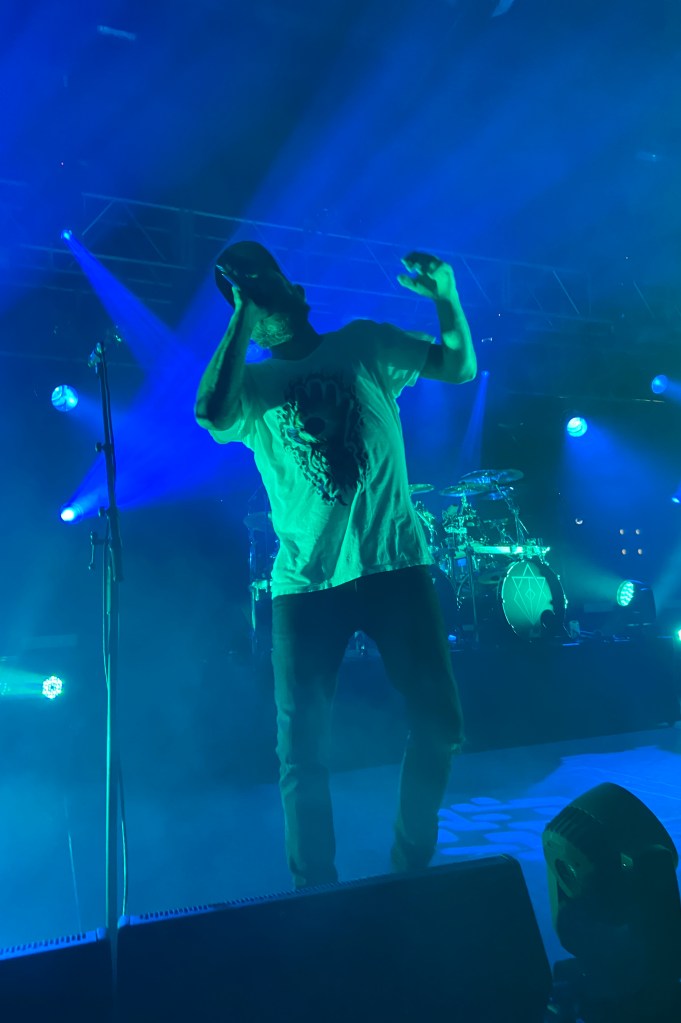
Anders Fridén was relaxed and full of energy as he and In Flames took the stage at the Starland Ballroom in Sayreville NJ, on Thursday, September 8. Anders took us through a tour of In Flames metal history, with the band playing songs from several of their earlier albums (1994’s Lunar Strain, 1996’s The Jester Race, 1997’s Whoracle, and 1999’s Colony). To be honest, as somewhat of a newbie, I think I was the only one who couldn’t sing along with those songs. (Working my way backwards through their catalog, I’m only up to A Sense of Purpose, with a detour to Clayman).

In Flames also played their two most recent releases, with Anders promising a new album is the on the way—can’t wait for that!

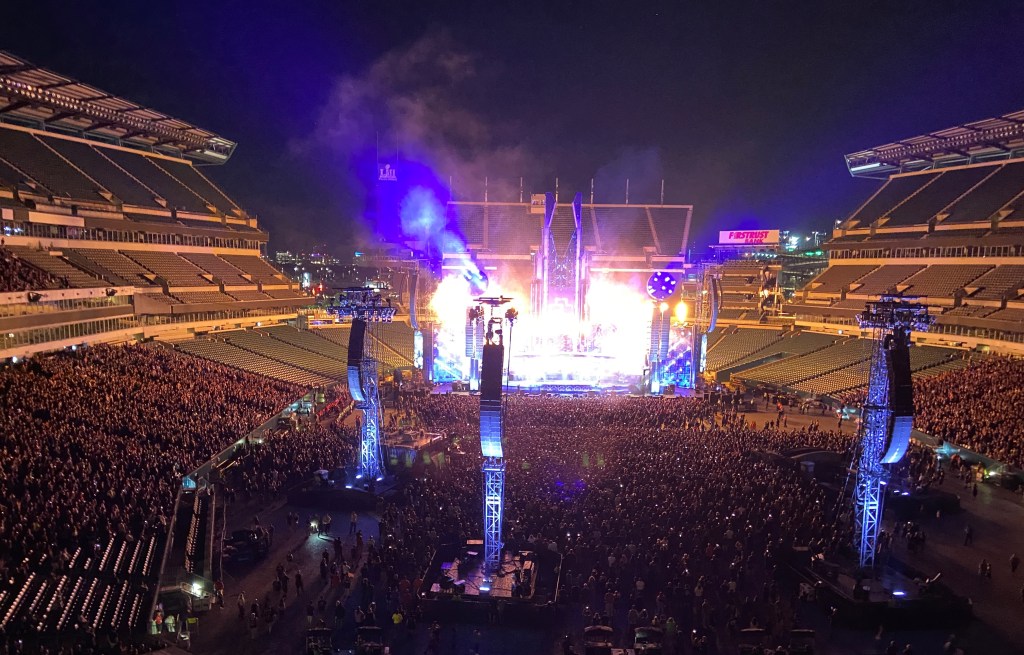
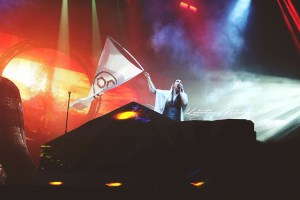
This show was in sharp contrast to the Rammstein show we saw the week before. Rammstein’s arena show was a fantastic display of the band’s particular kind of artistry, but its grand scale prevented any sense of connection with the band.

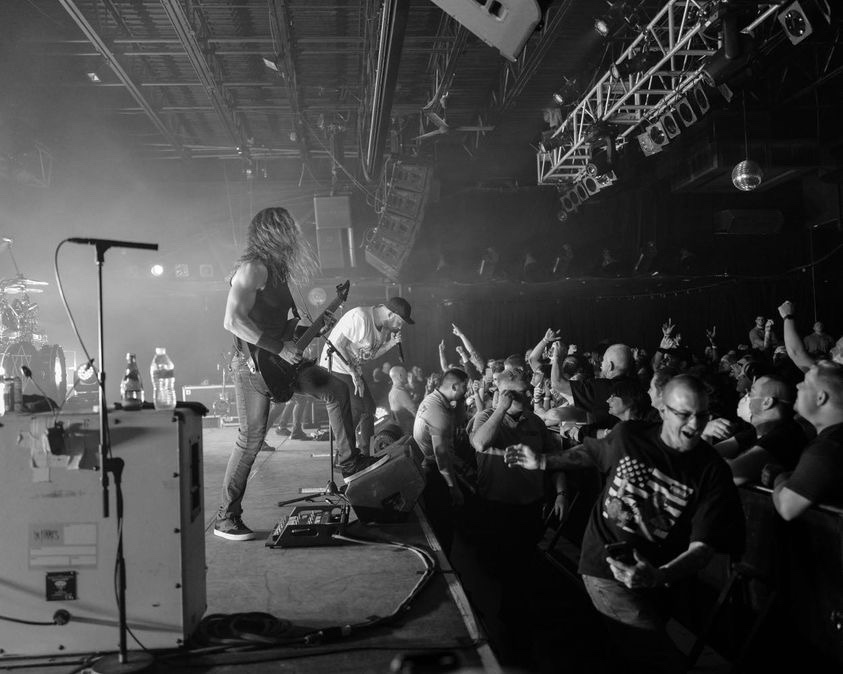
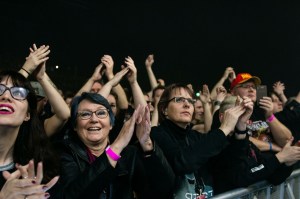
Not so on Thursday. Anders’ easy banter, the mix of old and new songs, the fans’ over-the-top enthusiasm, and the intimate size of the venue, made for an exhilarating night. Well warmed up by the supporting bands, fans immediately got down to moshing and crowd-surfing, and the turned-up-high bass made sure every molecule in the room was bouncing.

In Flames was supported by Vended, Orbit Culture, and Fit For An Autopsy, all new to me—but not to the crowd—and I will be checking out their music further, especially since our pub waitperson the following night told us he was a big fan of Vended.

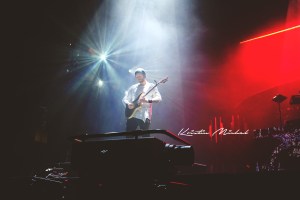
Here are a few of my pictures, but my daughter, photographer Kristin Michel, has far better ones; visit her Facebook page.

This photo by @robertsiliato besutifully captures the energy of the night (and I’m so happy to be in this picture)!

Rammstein at last!

Rammstein

Lincoln Financial Field, Philadelphia, PA

August 31, 2022

I have been aware of Rammstein for a long time, possibly from 1998, when the band was banned in Worcester, and Till Lindemann and Christian “Flake” Lorenz spent a night in jail. I suspect that event may have put them on my radar as a bad boy metal band, as it certainly would have been news in puritan New England. (Check out stories by Revolver Magazine and the Worcester Telegram & Gazette.)

I bought Metal Hammer’s March 2019 issue for a story on Within Temptation. The issue featured Rammstein on the cover, and I read every word of that story. Something about them resonated with me. Maybe I understood them as committed artists who were uncowed by critics and unintimidated by authority, or maybe it was simply because they knew how to play with fire. If they toured anywhere nearby, I was going to be there.

New Year’s Day 2020 drew to a close, and my daughter and I wanted to make 2020 as great a year musically as 2019 had been. Scrolling through Ticketmaster looking for shows, we found Rammstein’s North American Tour. Knowing it would be a flaming good spectacle, and having been severely let down by our Iron Maiden nose-bleed seats located so far to the side that we could see nothing of the action on the stage, we bought the best center seats we could afford, and my son-in-law agreed to join us.

Then in March, pandemic.

Rammstein’s tour was postponed, and postponed, and postponed. But now, at last, three years later, here we are!

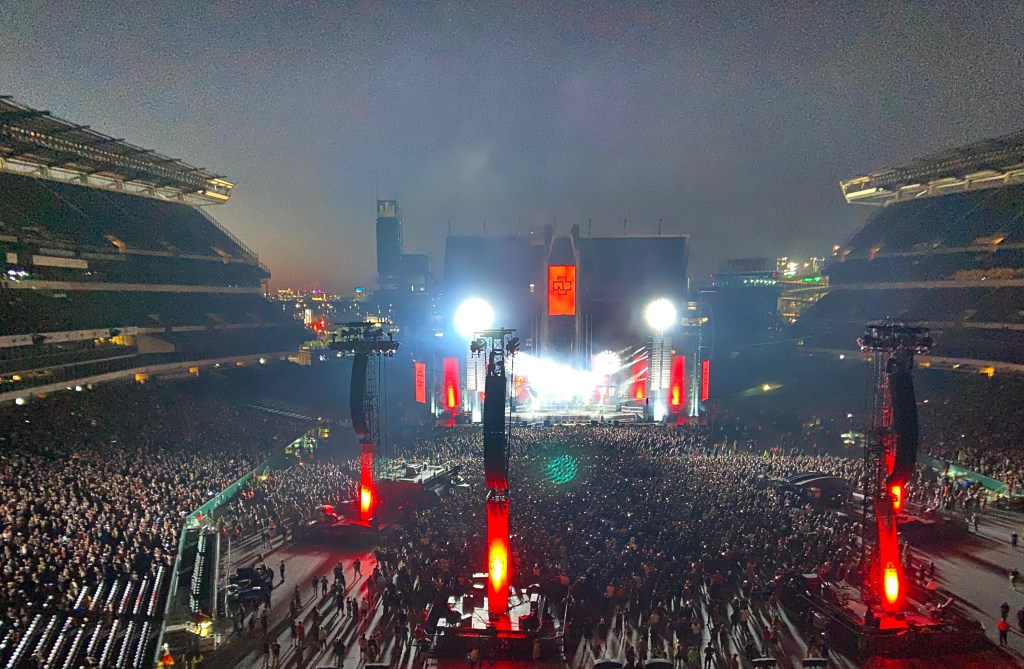
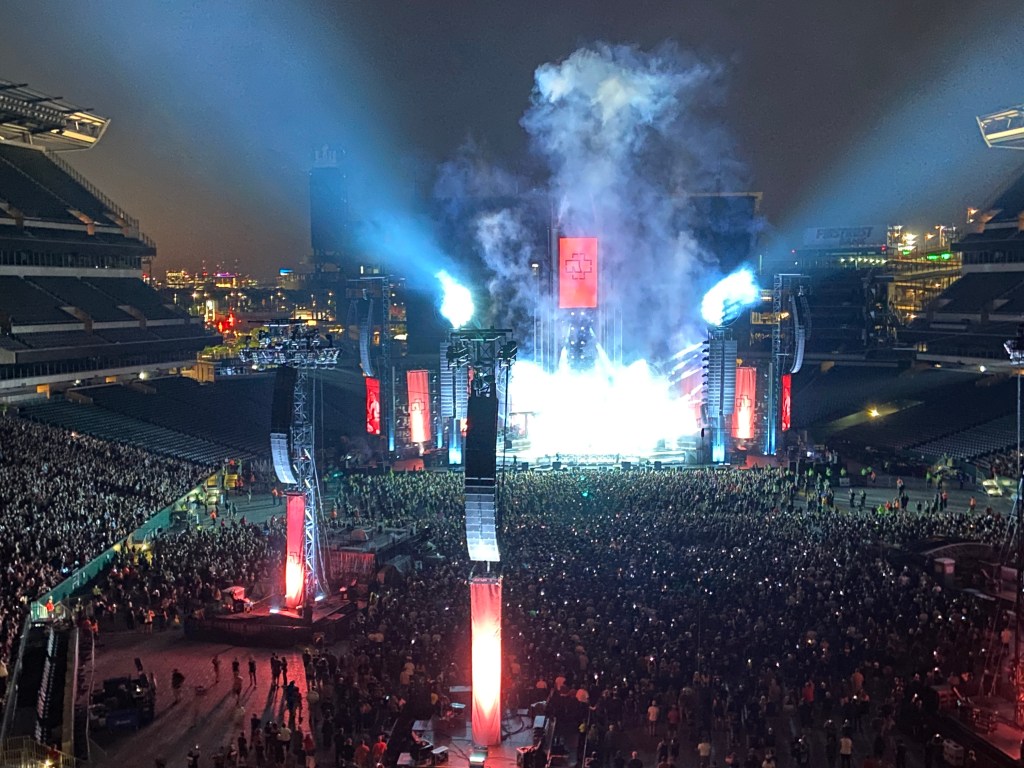
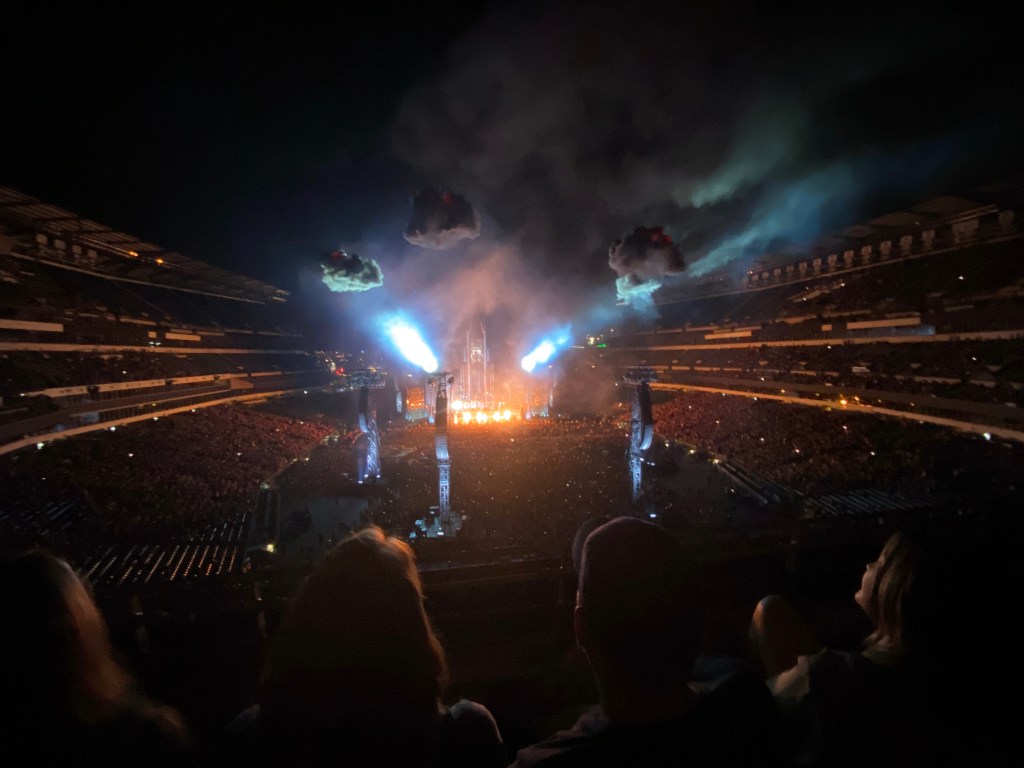
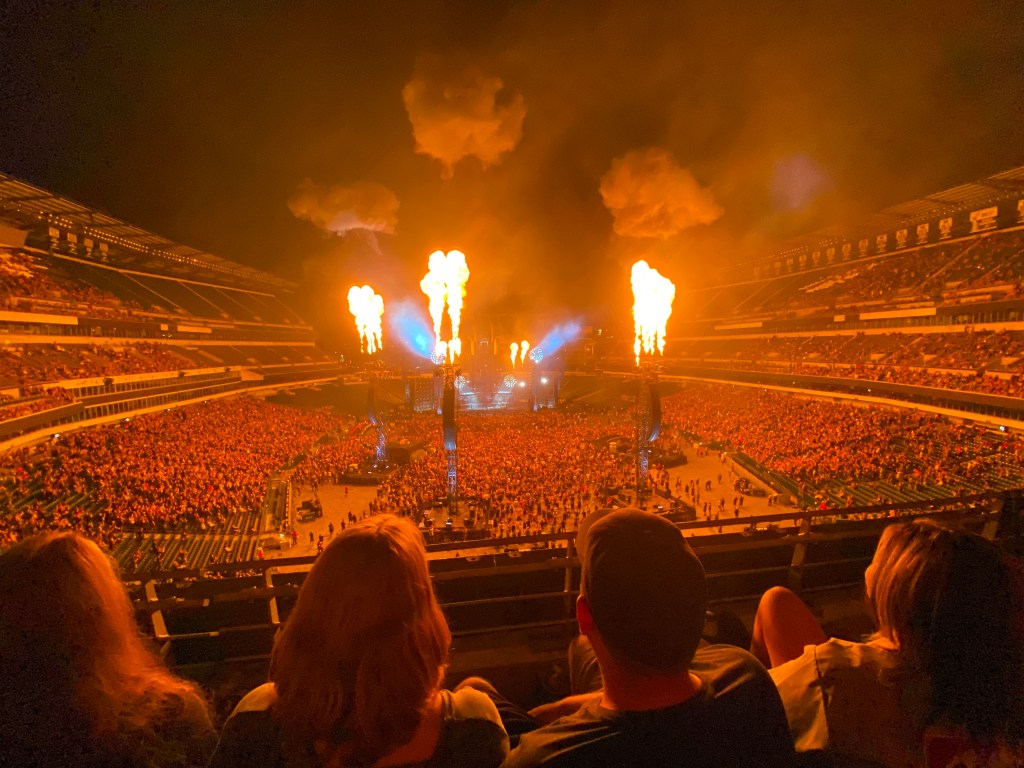
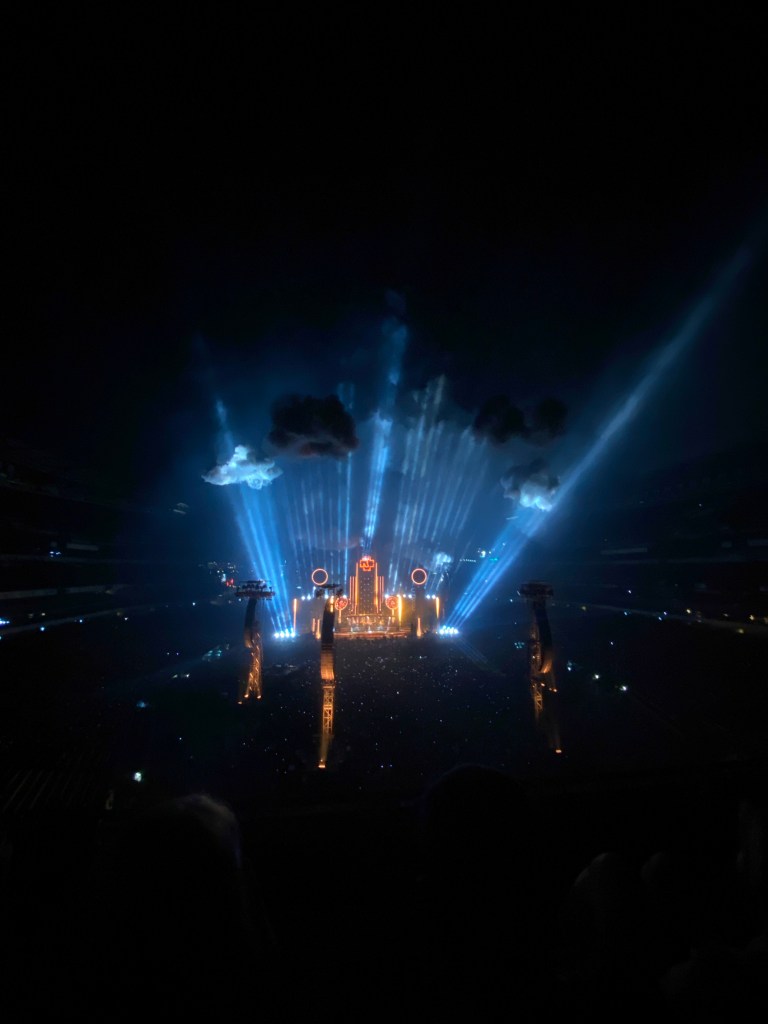
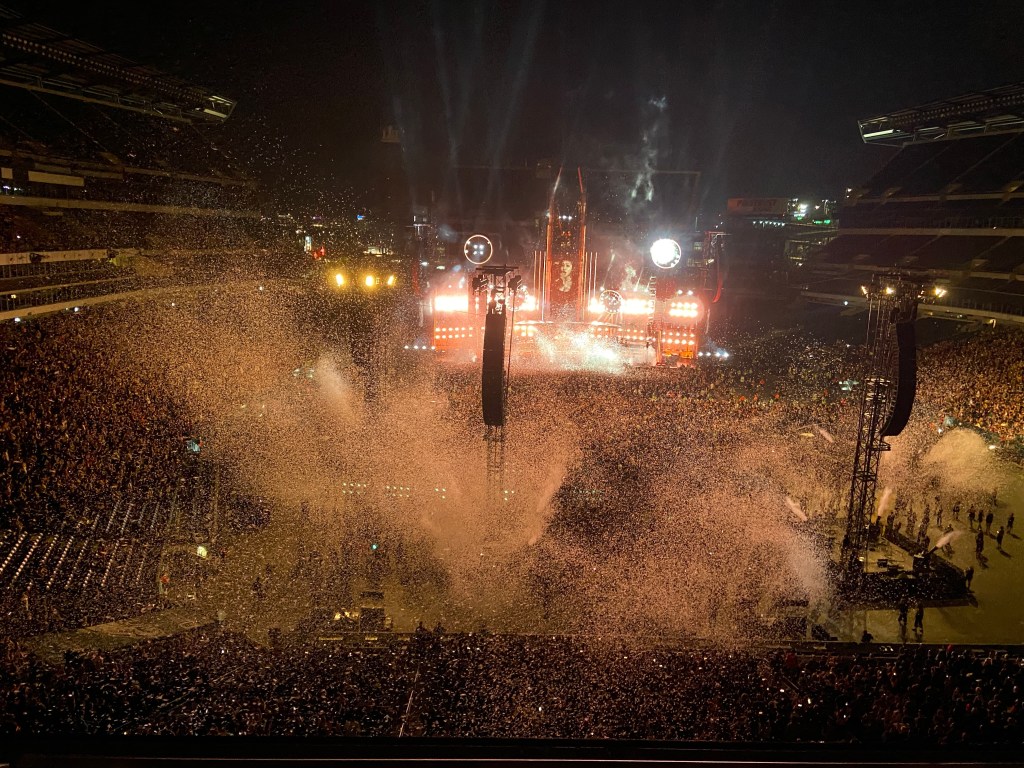
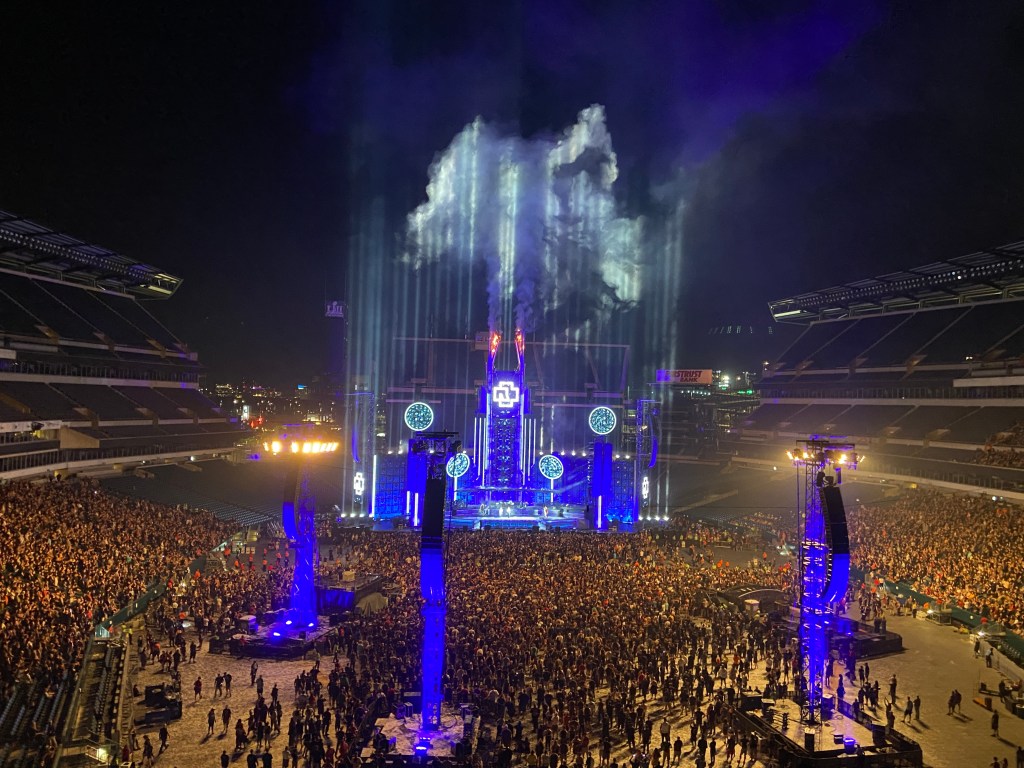
On Wednesday night, I was expecting spectacle. But this spectacle was far beyond anything I have ever witnessed in my life. It was performance art—breathtaking—quite literally. At points, I sat there transfixed in my seat, holding my breath in anticipation of what could possibly come next. The music pounded, pummeled, rumbled, and skewered us. Till’s sonorous vocals ranged from throaty whispers to screaming rage. And the fire! Did I mention there was fire? Incredible pyrotechnics toasted us even up in our aerie seats.

Here are a few of my pictures. You can find more by Bill Raymond/Digital Noise Mag here. The setlist is here, and Kerrang! has an article discussing Rammstein’s 20 greatest songs, many of which were included in the show.

Feeling Alive Again: Kingdom Collapse and the Return of Live Music


A week ago Friday, I got in the car to drive to my daughter’s in Pennsylvania with a strange feeling of trepidation, like waiting for the other shoe to drop. Like something was bound to happen to derail the weekend’s plan—to attend my first, in-person live music event in over two years.

It has happened before. Like so many people, we had a bunch of shows lined up for 2020, and all, of course, went by the wayside, some cancelled outright and others keeping us dangling, with reschedule after reschedule. 

Over the last two years, my family has been very cautious. Unwilling to jeopardize our own health or the health of others, we have avoided crowds, busy times at the grocery store, and generally followed the Covid-19 guidance. But once we received our boosters, we agreed that the time had come to learn to live with the virus. You can’t avoid risk entirely; risk is a part of life, and unfortunately, so are viruses.

Now, with life returning to near normalcy, with bands announcing tours practically every day, and being fully vaxxed and boosted, I knew the time had come. So I began to watch social media for the right show in the right place.

As I’ve explained elsewhere, I’m new to this live music stuff: my first live, in-person concert ever was in November 2018. After that, my daughter, Kristin, and I caught a lot of shows in 2019—In Flames opening for Within Temptation (3 times), Iron Maiden, Evanescence, Papa Roach with Asking Alexandria and Bad Wolves, and the Impact Music Festival in Bangor, Maine, where we caught KillswitchEngage, Five Finger Death Punch, and Godsmack among others. Sabaton’s Worcester show was my first “solo flight”. It was a crazy fantastic year, and I put a lot of miles on my car as I ran up and down I-95. My last show of the year was In Flames, when their headline tour returned them to the States in December. After that, we made a lot of plans for 2020.

And then of course, nothing.

Music is addictive, I’ve come to find out, and live music especially so. That first moment when the guitars shred your chest and every atom in your body reverberates—nothing else is like it. The first time I experienced it, it was a rush like no other. I never felt so alive, and every show since that first one has felt the same.

But it’s not just the music, or seeing a favorite band live. Something else happens in that time when you’re standing packed together on the floor with hundreds of other people all there for the same purpose. It’s a unity of spirit, a connection, like we are all part of a clan or a tribe. The vocalist cries “Jump!” and we all start jumping. Watching the crowd-surfers leaves me breathless; after all, what is crowd-surfing if not a demonstration of trust—trust that all those strangers won’t drop you (at least not intentionally)? And the moshers’ crazy, primeval spiral dance—surely it taps into some ancient ritual of community.

Those first notes explode with feeling—connection, art, life itself—and as I stand there, shoulder to shoulder with other fans, I understand my connection to the world, to people. We are all there for something we all love, to participate in artistic creation. Every show is new and vital. This is the thing about art (and yes, rock and metal music are arts)—without an audience, an artist is incomplete. And without art, we are incomplete.

This was the problem in 2020. I felt disconnected, free-floating, lost in a new reality, with nothing to ground me. Yes, recorded music was helpful. But there is simply nothing else like being there to jolt you back to life.

I’ve been following Kingdom Collapse since they popped up on my Instagram in 2021, when I first listened to their songs “Uprise” and “Unbreakable”. These songs resonated deeply, coming as they did upon the heels of a tumultuous presidential election and the pandemic.

When Kingdom Collapse initially announced that they would be an opener for From Ashes To New (FATN) on their Still Panicking Tour, the dates were all in the West and Midwest. But later, Reading PA showed up on the list. I stared at the post, and thought, I need to do this. I usually go to shows with my daughter, and Reading is in her neck of the woods.

Kristin was game to come along, so we bought tickets and waited. Finally, on that Friday, as planned, I hopped in my car for that 6+ hour drive. (She wasn’t home when I arrived—pause for shameless family promotion—she was photographing Shinedown’s concert in Hershey; see her Shinedown photos here).

Saturday started gray, with frost in the forecast, despite being mid-April. We did some antiquing in Adamstown, Pennsylvania (said to be the Antiques Capital of the USA) in the afternoon, and here the shift back to a normal world was evident. I’d been down here in March (when we discovered this area and vowed to come back) and people were masking against the last grip of the pandemic. But today, no masks. It was as though the pandemic never happened.

After busting our budgets, we drove the 16 miles to Reading. On the way into town, we scoped out the line at the Reverb—no one in sight—and thought we had time to grab a little fast food first.

Twenty minutes later, we headed back to the Reverb, with rain starting to spit. Even though we were 45 minutes ahead of the doors opening, a long line had appeared. We saw lots of FATN shirts, along with several shiny new Shinedown shirts. We hugged the side of the building to avoid getting doused–every so often water poured off the narrow roof ledge above as though someone had turned on a faucet.

The Reverb staff were very organized—paper tickets go here, electronic there—through a little anteroom, and we were inside. The Reverb is a large room with a round bar in the back center and stage opposite. At this moment, a misty cloud hung about the stage area suggesting smoke machines had been tested.

We were too late to get right up front, so we hung back to one side, to avoid any moshing that might start. The Reverb is small enough that wherever we stood, we’d have a good view. Another group of Kingdom Collapse fans was gathered near the bar.

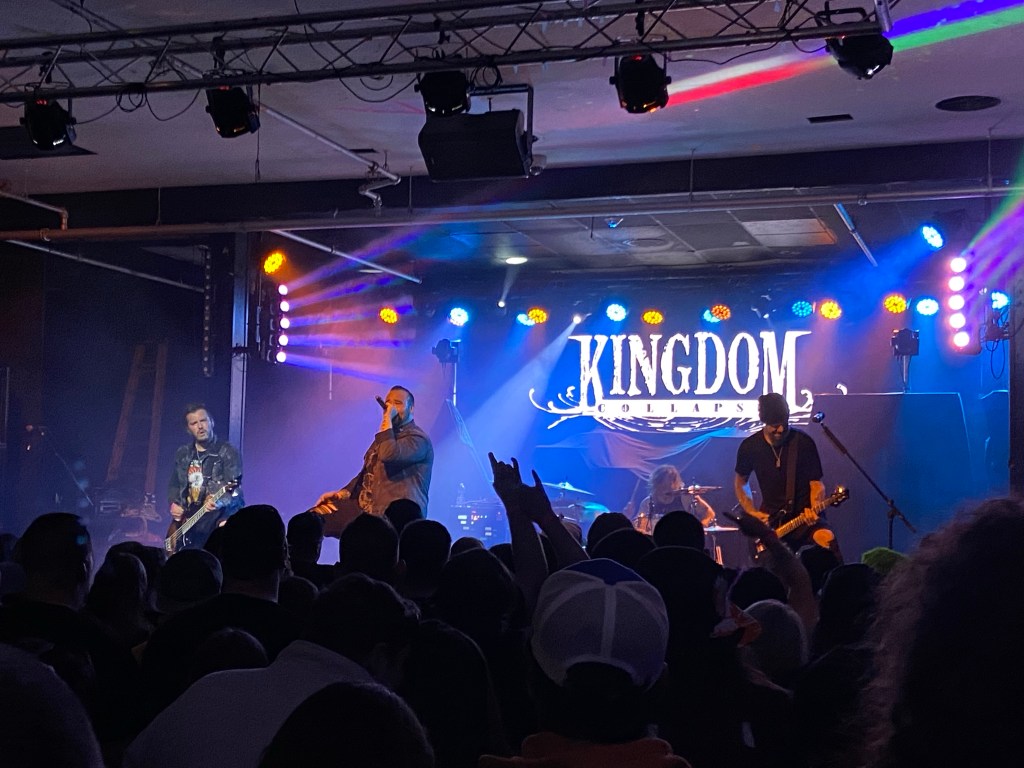
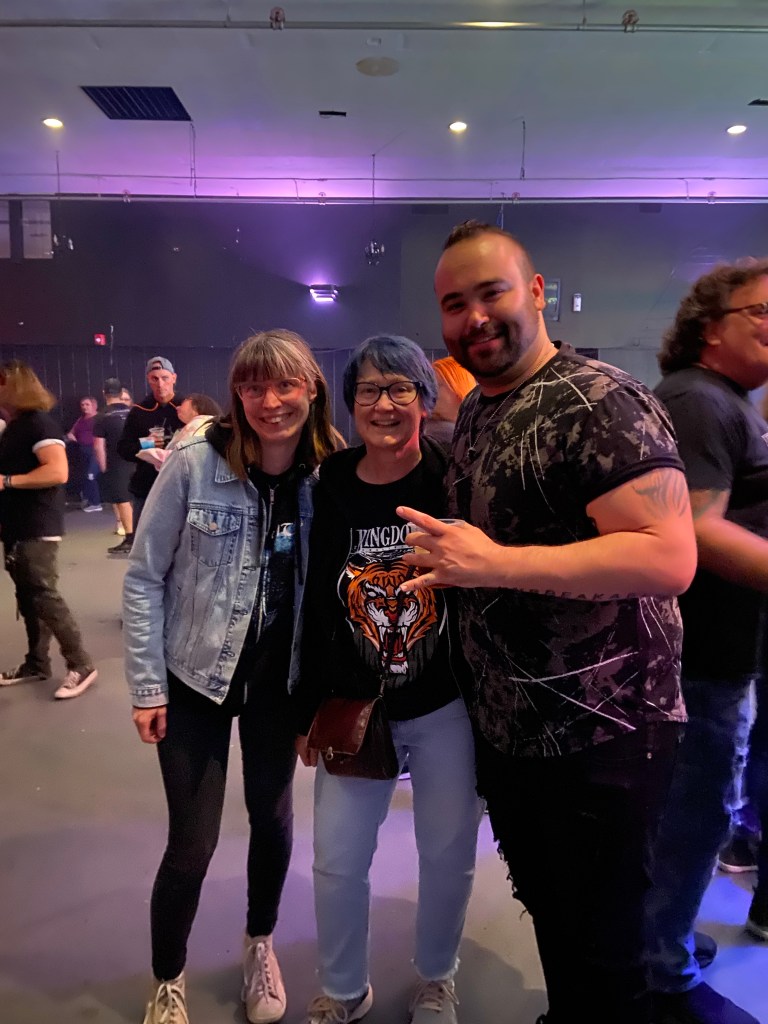
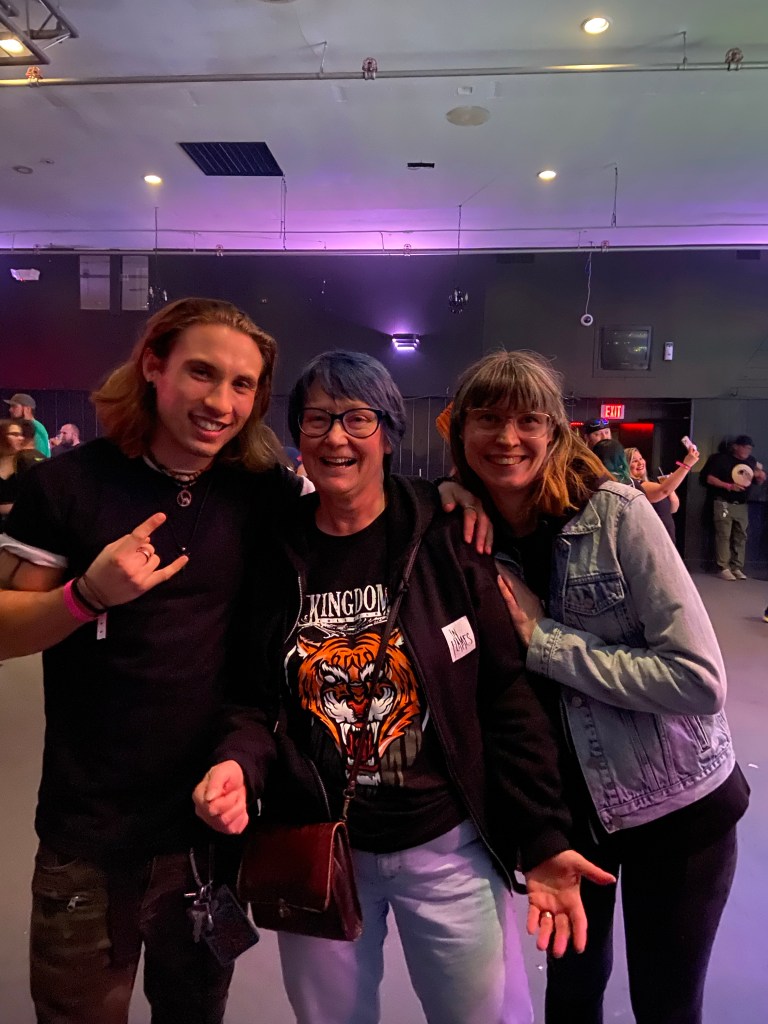
Kristin and I were chatting and observing the scene when I happened to look in the direction that Kristin was looking, to see Jonathan Norris, the Kingdom Collapse vocalist, striding toward me, smiling, and asking if he was pronouncing my name right. And he was, perfectly. We had a great talk for about ten minutes; Jon mentioned the band is working on an album, and the challenge was the volume, the number of songs needed. “It’s about quality, not quantity,” he said. “Every song has to have the quality we want.” A few minutes later, Elijah Santucci, the band’s drummer, came over and introduced himself and chatted with us awhile. He caught up with us again at the end of the night.

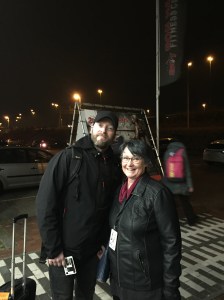
Jon Norris, right, with me and Kristin, left
With Eli Santucci

Kingdom Collapse was the right band to break my pandemic live-music fast. An independent band, they have, through their own hard work over the last two years—during the pandemic, no less—arrived at an amazing place. Their songs “Uprise” and “Unbreakable” have spent weeks on the Sirius XM Octane Biguns Countdown, and their latest release, “Save Me From Myself”, appears destined for the same fantastic fate. The band did not let the upside-down world of the pandemic blow away their dreams. Instead, Kingdom Collapse has given us songs that tell us we are not alone, not disconnected, that we are in this together, and together we can get through anything.

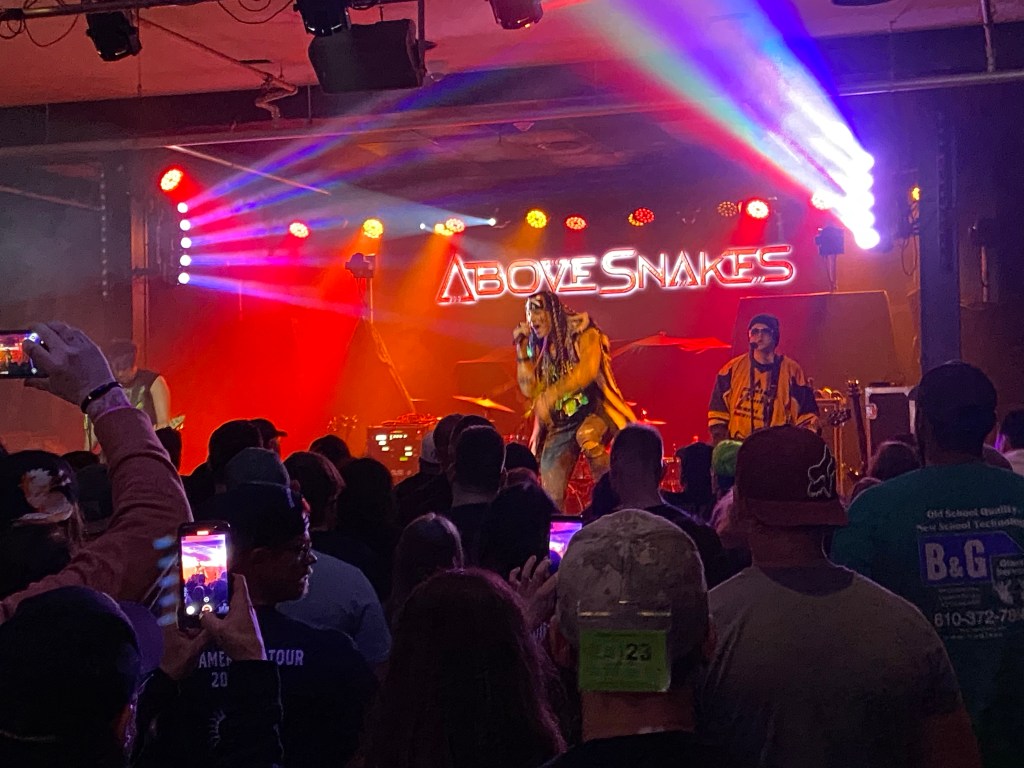
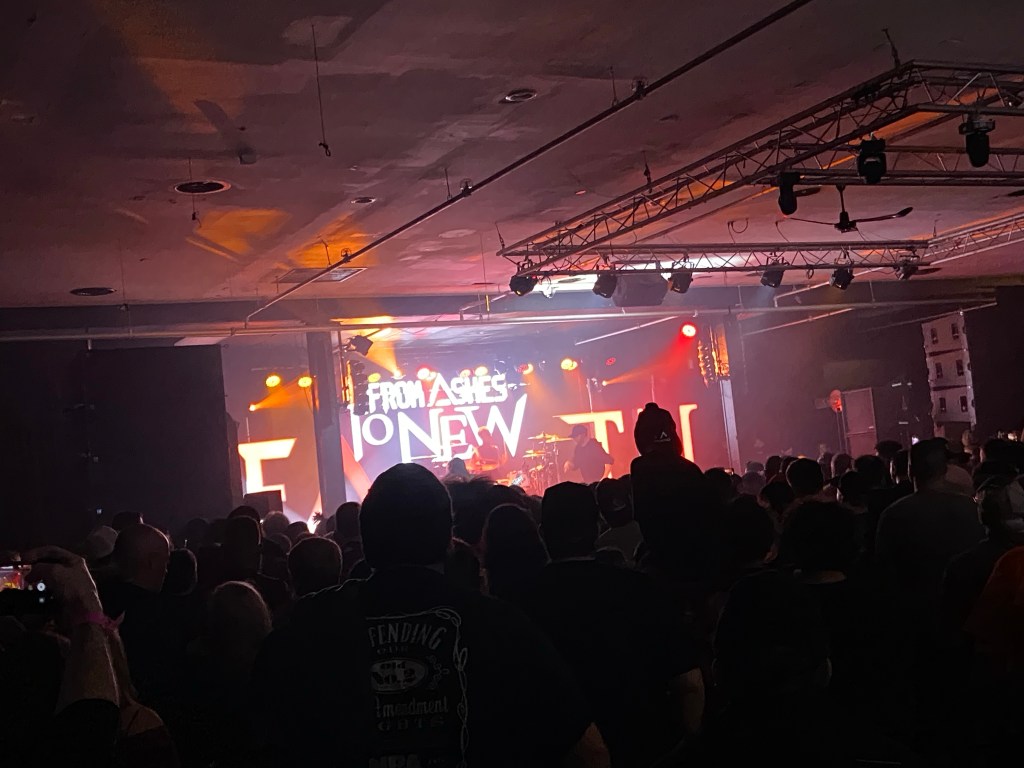
Kingdom Collapse’s set was powerful despite this being the last show of the tour. They delivered that burst of vital energy I needed. And the energy level never dropped through the rest of the night. I went to the Reverb to support Kingdom Collapse but came away discovering a couple of new (to me) bands. I was already familiar with headliners FATN and Fire from the Gods. Both were early favorites in my new musical life, FATN’s “My Name” and Fire From the Gods’ “Right Now” having had a lot of play on SiriusXM’s Octane. In the coming weeks, I will be checking out the music of Above Snakes (from Boston) who opened the night, and Blind Channel (from Finland).

Toward the end of FATN’s set, we headed outside, to get a head start on departing the parking lot. The night was quiet—no clues to the excitement inside the building. The air was heavy with a cold dampness that suggested snow, and a few cars were dusted with frost. The cold front had arrived. Time to go home.

But time too, to plan ahead for the next concert—Metal Tour of the Year, in May, to see In Flames—and what I hope will again be my new normal: another year full of live music. Can’t wait. Stay tuned.

Books: Not Just Another Rock Bio

Noise Damage: My Life as a Rock ‘n’ Roll Underdog by James Kennedy, Lightning Books Ltd., 2020

Noise Damage is a great read. It’s written in a breezy, honest style that makes you feel like you’re sitting in a pub with Kennedy as he regales you with his story. But it also feels like you’re peering into a hidden world. If you’ve ever been crushed in the pit at a rock concert and wondered what it’s like to be up there, to get on the bus every day and do it again and again, if you’ve wondered how they got there and why —Noise Damage will tell you.

Noise Damage is the story of a guy from backwater Wales who just wants to be a rock star. But the book is also a memoir, a soul-searching telling of what it means to claim your real calling. In Kennedy’s case, that calling is making music.

Born in 1980, Kennedy grew up in a working-class family in south Wales. Leaving Cardiff not long after Kennedy was born, the family moved first to a gritty, urban area, and then to a village “in the middle of bloody nowhere.” On his ninth birthday, Kennedy’s dad gave him a little Spanish guitar (that he later learned his father had “nicked from somewhere’) and showed him a few things on it. “I played that damn riff over and over (and over),” Kennedy writes, “maybe a thousand times, and the fact that I could actually do something with this thing made me feel like I’d just discovered a buried superpower.” After a few “lessons” from a one-legged, Hendrix-worshipping local guy called Sid, Kennedy knew he could only be a guitarist.

But the path to rock glory would not be easy. The road took a serious turn a year later when doctors found tumors in both Kennedy’s ears. Surgeries left him with only sixty percent of his hearing and ferocious tinnitus.

Kennedy was a “frustrating paradox”, struggling through school despite being a voracious reader well-versed in literature, history, and politics; he celebrated the end of high school by setting fire to his uniform and books. But high school was a means to an end: getting into college to study music.

Through sheer will power, Kennedy made it to college, where he encountered music theory for the first time—and snagged an opportunity to work in a real music studio.

Once Kennedy found his way around the studio, he seized a further opportunity—to make an album, “the album, that threw all of the things I loved into one giant, ambitious, uncommercial, multi-genre melting pot of seething, unpredictable musical indulgence [with] an angry dose of politics and … filthy noise and pounding drums.” This was Made in China, his first CD (later remade as Kyshera’s 2nd album in 2012).

With his no-holds-barred approach and absolute belief that he could do whatever he set his mind to, coupled with the digital technology that was changing the music industry, Kennedy made the entire album himself, writing and singing every song (despite having never written or sung a song), playing every instrument—digitally or otherwise—recording, engineering. It took two years of putting in every spare moment, often working through the night, until it was done. Then Kennedy even handled his own promotion, mailing CDs to all the music magazines.

This is where Kennedy’s story really takes off. Awash with rave reviews, every interviewer and industry big-wig wanted to know: “When are you next performing in London?” Kennedy had to get a band together. After plastering most of Wales with recruitment flyers (no social media, no internet back in the day), his band, Kyshera, began to take shape.

Kyshera’s run was a roller coaster ride. From crazed, screaming drummers and the exhilaration of the band’s first gig to the hard reality of the music industry’s crash and burn; from their first festival—before a crowd of bikers, where frontman Kennedy managed to fall and slash his face open in the middle of the set, spraying blood everywhere—to endless weekends playing covers to make money just to put gas in the bus to get to the next gig. A trip to Toronto for a major festival proved to be the gig from hell with a full-throttle adrenaline rush, sufficient to lure them back a second time—all against a backdrop of trying to hold on to the day job and have a personal life.

Peppered with British-isms, you might wish you had a Duolingo app for British slang. And if the “bad” words were left out, Noise Damage would be a much shorter read—I warned you it’s honest writing! And don’t read this book to get an understanding of the music industry or how to break into it; Noise Damage is not that.

Noise Damage is about coming of age, about truly embracing one’s calling no matter what it costs. And these days, when kids are forced to decide their direction early on, Noise Damage stands as a truthful telling of what it means to pursue your dream in a real world that can be brutal, unkind, and downright mean. Noise Damage is also an expression of irrepressible spirit, persistence despite significant odds against success, and the saving grace that is music.

Next time you get to a concert early to claim your spot at the rail, and you’re confronted with a band—the opener—that’s not the one you came to see, give them a listen anyway. As Kennedy says at the end of Noise Damage: “P.S. Please support artists. It’s harder than it looks.”

I first came across James Kennedy’s music through a tweet from July 2020, promoting the first single from his most recent album, Make Anger Great Again, “The Power”.

For something completely different, try Kennedy’s latest release, “Insomnia”.

You can also find on Spotify the audio book of Noise Damage, read by James Kennedy.

James Kennedy is also on SoundCloud & Bandcamp.

On Writer’s Block

I have decided to own my writer’s block—the reason I haven’t posted in a long time, since January.  I have felt incompetent, like my writing is silly, frivolous, worthless. I’ve been ruminating on this for months, turning the idea over and over in my mind, poking at it. I’ve come to see that writer’s block is more than mere “fear of the blank page”—it’s complicated.

Our “fear of the blank page” is fear of writing—fear of what happens when we write, of what might happen after we write, fear of what might happen if someone ever reads what we write, fear that our writing might be less than perfect. But is that all it is?

If you google “writer’s block”, you will get thousands of hits. My admittedly cursory review finds that many of the hits are lists: 15 surefire strategies to beat writers block! Thirty techniques that work! Most offer ways around writers block, ways to trick your psyche into writing, showing you how to crawl in through the back door, by working on character development, for example, plot lines, or eavesdropping on characters, even simply skipping the first sentence of the story and starting in the middle. (How is that less frightening?)

My googling led me to Maria Konnikova’s New Yorker article, “How to Beat Writer’s Block”. She describes the 1940s work of Edmund Bergler, a psychoanalyst who believed that writers who are blocked should seek psychotherapy because it is their subconscious issues that are blocking them. Later, Yale University psychologists Jerome Singer and Michael Barrios conducted a study of blocked writers, and found that all were unhappy, though for different reasons. The writers they studied fell into four categories: an anxious group, an angry group, an apathetic group, and a negative group. All the groups were found to lack motivation to write and their ability to create mental imagery was decreased, but these problems were rooted in different issues among the groups.

Of the anxious group, Konnikova says, they “felt unmotivated because of excessive self-criticism—nothing they produced was good enough—even though their imaginative capacity remained relatively unimpaired…they could still generate images, [but] they tended to ruminate, replaying scenes over and over, unable to move on to something new.”

When I read these words, I wanted to grab my tinfoil hat because someone had been peering into my mind. The novel I have been thinking about has been stalled while I replay the opening scenes over and over. Indeed, I considered and reconsidered this post many times before I sat down two months ago to begin typing it out, and since then—well, let’s just say I’ve continued to “revise” and “edit” it in my endless quest for perfection.

In the research study, the blocked writers were given prompts to work with, which over time alleviated their blocks. The upshot is that creative work can itself be a kind of therapy, and just writing can be the path through writers block.

Natalie Goldberg inherently understands this, although she has said she doesn’t believe in writer’s block. In her book, Wild Mind: Living the Writer’s Life, she acknowledges the subject by distinguishing waiting and procrastination. Waiting is when you’ve been working on something, percolating it, but “procrastination is pushing aside or putting off writing. It is thinking the moment is tomorrow.“  Waiting is “when you are letting writing work on you…Waiting is when you are already in the work and you are feeding it and being fed by it. Then you can trust the waiting. Do not use the excuse of ‘waiting’ for the right idea or story in order to begin. That is procrastination. Get to work.”

This is Goldberg’s approach, writing as practice, as discipline—just write, write through it. When you think you can’t write, just write, write in notebooks that no one will ever read, keep your hand moving. 10 minutes. Go.

I have procrastinated for years. Although writing has always been what I do best, the fear and perfectionism it engendered made me put it off—until I’m older, until I have more life experience, until I have more education or knowledge. The right moment to write was always tomorrow. But the clock ticking away in the empty nest must have triggered something. If I don’t have enough life experience by now—in my mid-60s—I never will. The time for procrastination was over, and a couple years ago, I began trying to write again.

But procrastination isn’t all of it. Stress—whether induced by cataclysmic life events, work, or family issues—gets in the way of writing, blocks us in a different way. Lately, I may want to write, but something always gets in the way of writing: the “shoulds” of my life—all the things I should do before taking the time for myself, to write. Even if I sat down to do “10 minutes—go!” the shoulds would overwhelm and defeat my writing.

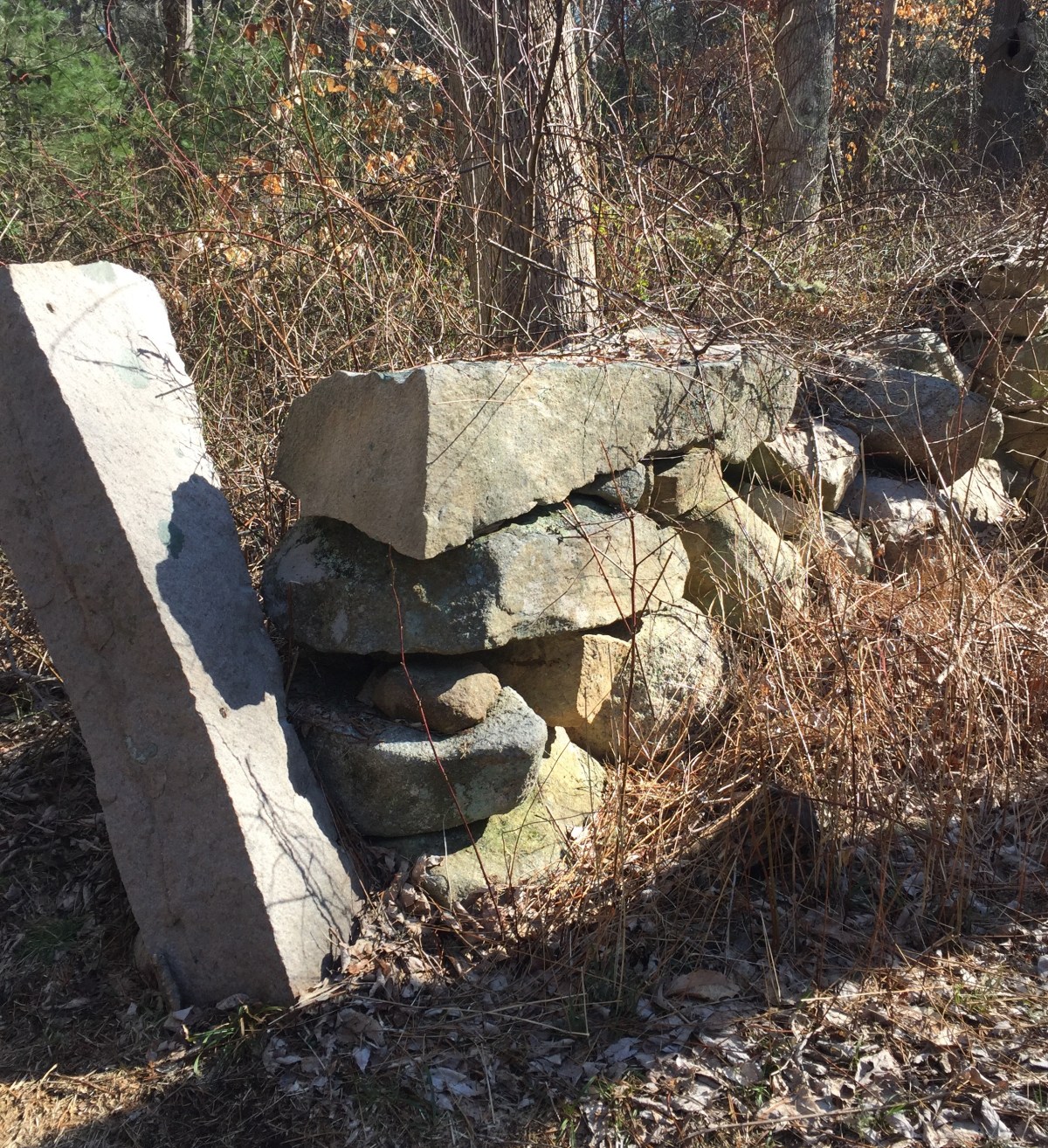
I’d thought of writer’s block as a block—a huge cube that I must clamber over. But that’s not it. Writer’s block is more like a New England stone wall, trailing through woods, meandering across the countryside, intersecting with other stone walls, like a maze. The wall is made of my fears, pain, angst, as well as the stress of life. It keeps me contained like a sheep in a pasture. But time and gravity will push stones, and some will fall away, creating a way out.  But to find it, I must keep writing.

Abbey Road Studios: A Milestone on My Long & Winding Road

2015 was a pivotal year for me. 

I grew up at a time when travel was limited to a privileged few, including briefly my grandfather, whose few business trips to Paris suggested the existence of a wider world. After I married, my husband’s active duty Air Force career bounced us back and forth between the East and West coasts. “Oh, you must travel a lot,” non-military people often commented, but, alas, we were firmly stuck stateside. 

I felt like I’d never get to go anywhere.

Over the years, my husband became increasingly involved in his professional society, IEEE, the world’s largest technical professional society, and quietly climbed his way up their volunteer ranks. In 2015, he took over as the volunteer President of the IEEE board of directors. One of the President’s key roles is to represent IEEE at various events around the world, and I was fortunate to be able to accompany Howard on his global travels that year.

One such event that I shall never forget is the Milestone presentation at Abbey Road Studios.

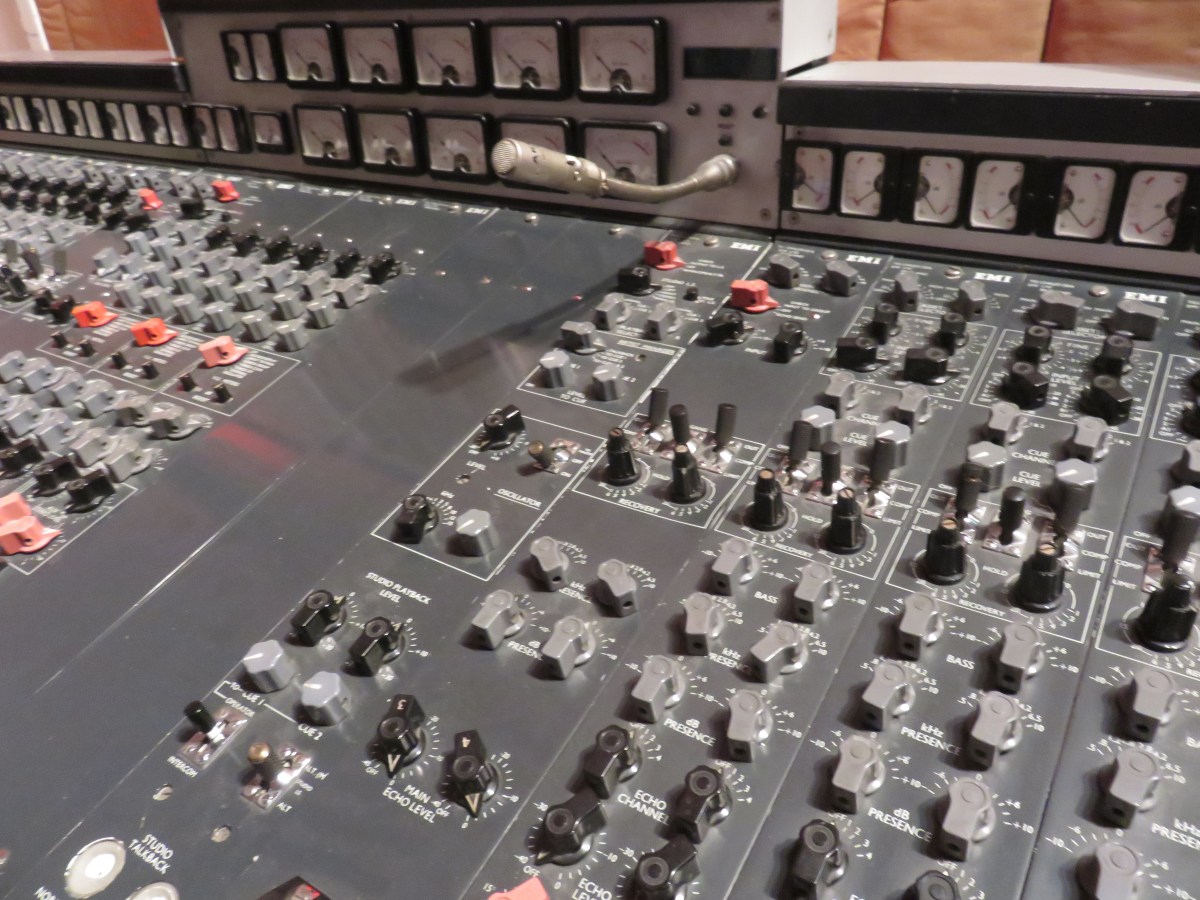
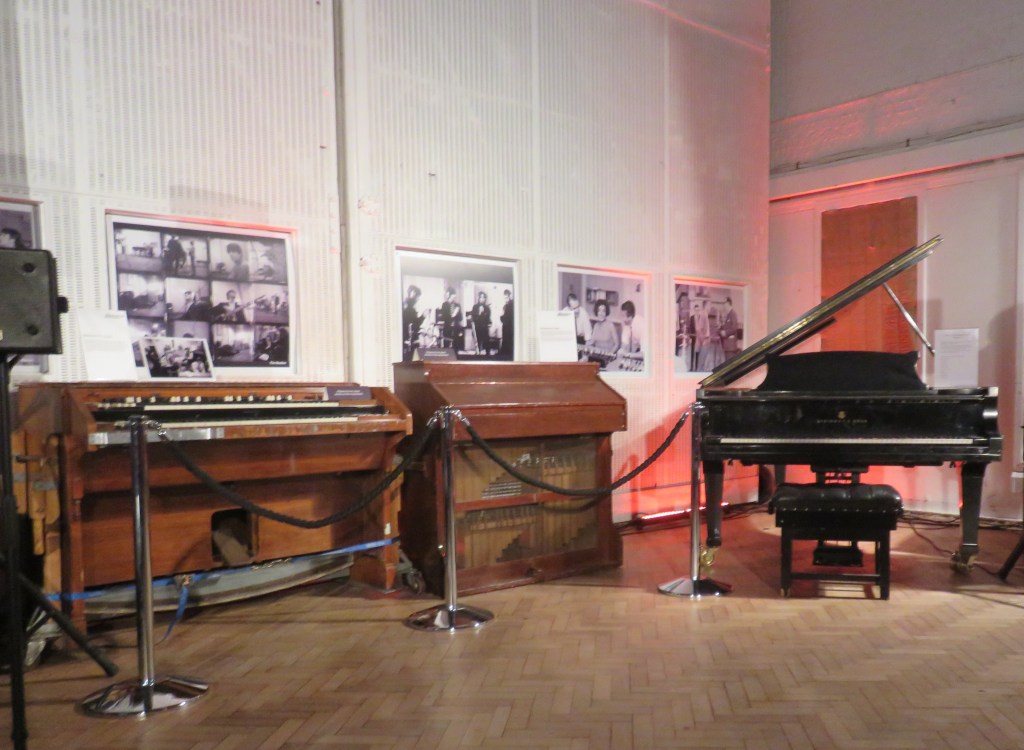
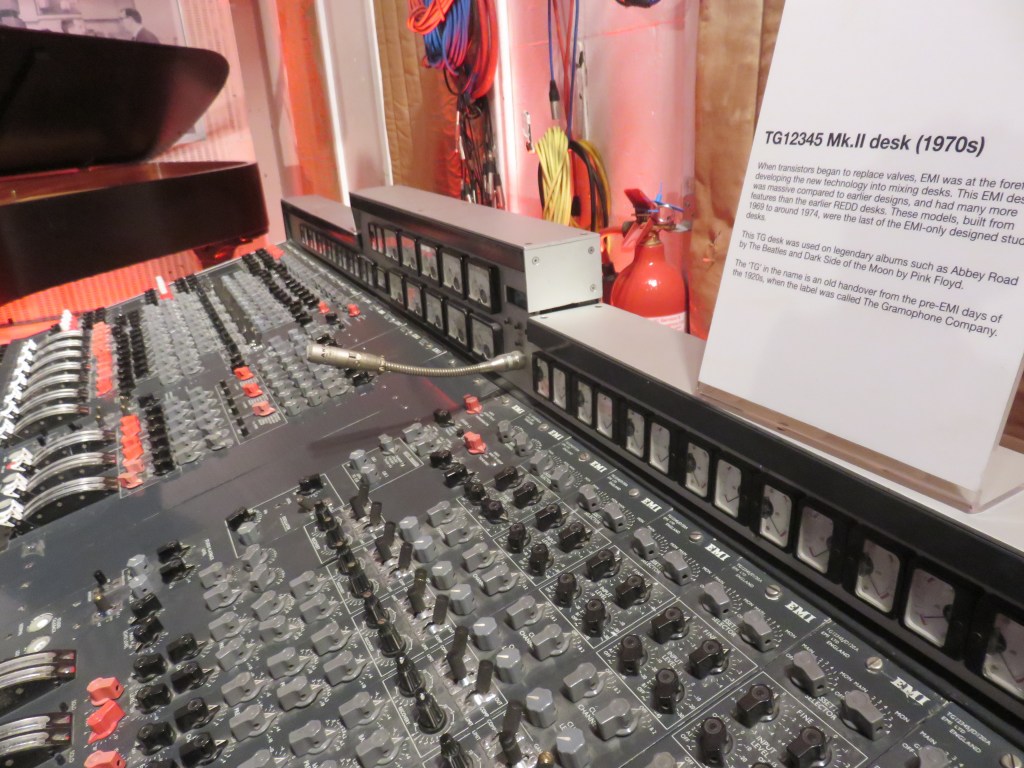
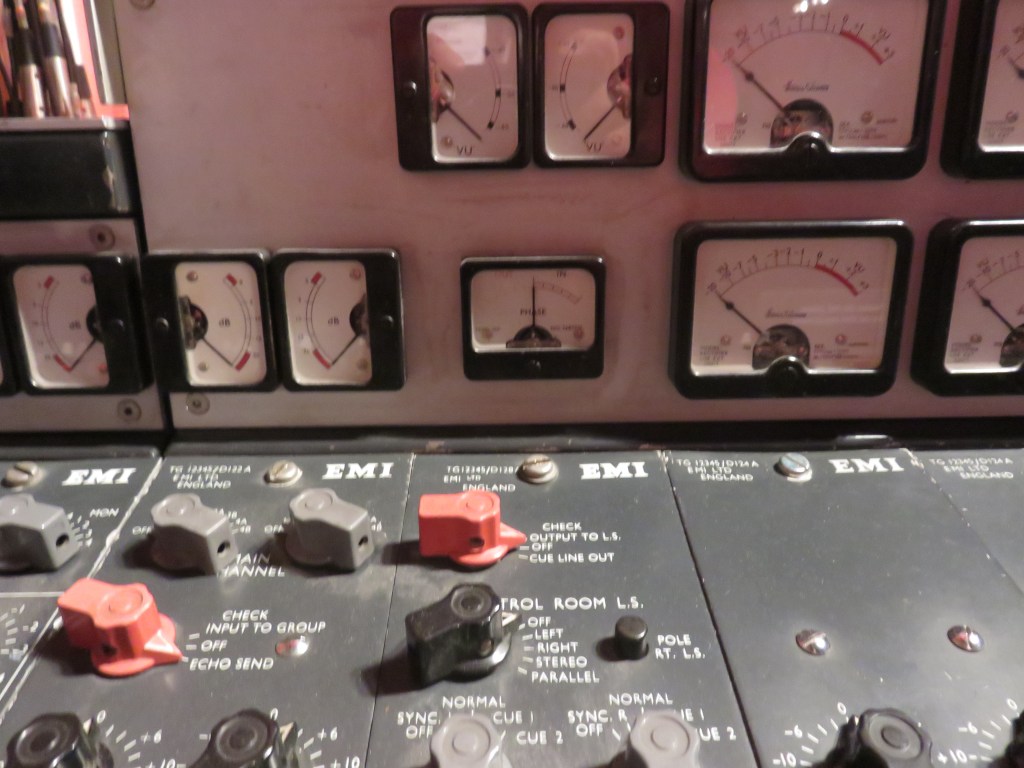
Abbey Road is, of course, the iconic recording studio of the Beatles, and so many others—from Pink Floyd, the Zombies, and the Hollies to the London Philharmonic, and movie scores, like Lord of the Rings. Abbey Road is famous. But it is also historic, with a place in history that led directly to the creation of our present world of sound, music, TV, and movies.

The 1829 estate in St. John’s Wood, London, was purchased in 1928, and in March 1929, a young engineer named Alan Dower Blumlein, joined Columbia Gramophone, one of the predecessors of EMI. (Electric and Musical Industries, better known as EMI, resulted from a 1931 merger between Gramophone and Columbia Gramophone.)

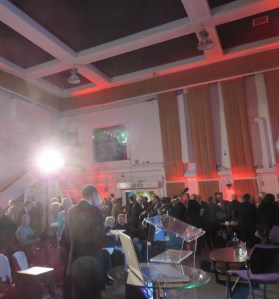
Inside Studio 2 for IEEE Milestone Presentation

Blumlein proved to be a prodigious inventor, filing 128 patents during his brief career. Blumlein filed his most famous patent in December 1931, when he was only 27 years old, “for improvement in and relating to sound-transmission, sound-recording and sound-reproducing systems” — what we know today as stereo

In 1931, while at the cinema, Blumlein told his wife he could solve the problem of the unnatural sound of those early movies.  Early movies and recordings were made with monaural (“mono”) sound. Because of its static nature, this type of sound is inherently unsatisfactory; flat and stationary, it lacks the dynamic quality essential to recreating a listener’s experience. Stereophonic sound solves this problem. Blumlein went on to make the first live stereo recording of the London Philharmonic Orchestra at Abbey Road Studios in 1934.
Howard Michel (left) with Simon Blumlein, son of Alan Dower Blumlein

Blumlein was not only an inventor on par with Edison and Bell. A true war hero, his work with radar inestimably aided the Allied effort during World War II. Blumlein was killed at the age of 38, when the bomber in which he was testing a new radar system crashed on a hill in Ross on Wye, England, on June 7, 1942.

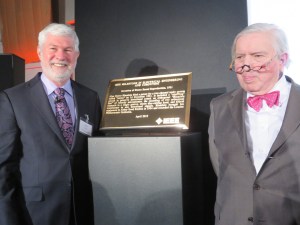
On April 1, 2015, my husband in his capacity as IEEE President, had the honor to present Abbey Road Studios with an IEEE Milestone, an award honoring “significant achievements in the history of electrical and electronics engineering”.

The Milestone was presented in renowned Studio 2 to Isabel Garvey, Abbey Road Studio’s Managing Director, and Simon Blumlein, son of Alan Dower Blumlein, thanked IEEE for its recognition of his father’s achievement.

For me personally, this event was a milestone along my own long and winding road, leading me back to the Beatles, and beyond.

#MerryMusic: Music for Your Happy Holidays, Christmas, Solstice, etc.

I’ve never been a fan of the standard “Christmas music” and its overworked carols and drummer boys and what not. I’ve always hunted for music that’s a little different. Out of my collection of “holiday” or winter music, assembled over the last 30 years or so (yes, there are few New Age CDs in there, an awful lot of Celtic music, plus one lonely Josh Groban), here are some that sing to me right now.

The most recent addition to my collection is Tarja Turunen’s From Spirits and Ghosts. Tarja is the former Nightwish vocalist and a true metal goddess, but this album is not what most folks think of when they think “metal”. This was the first Tarja CD I bought last year, because I found her rendition of O Come, O Come Emmanuel online (after discovering her through Within Temptation), and it is hauntingly beautiful (the video is, well, haunting). I have always found Christmas to be a bittersweet holiday, and Tarja captures that perfectly. Operatically trained, Tarja’s soprano is sweet indeed. Try Feliz Navidad.

For more of that moody, bittersweet quality, I love the old folk hymn, I Wonder as I Wander, as sung by Mary Travers of Peter, Paul and Mary, on A Holiday Celebration with the New York Choral Society. This 1988 album is a wonderful collection of less-often-heard songs, including a couple of Hanukkah songs and of course, Blowin’ in the Wind.

A heavy holiday isn’t complete without the Trans-Siberian Orchestra. I’ve had The Lost Christmas CD for many years, but it was buried in the back of the cabinet. So glad I dug it out! I love Siberian Sleigh Ride, but the whole album makes for a real head-banger’s holiday.

We bought Renaissance Holiday (presented by Chip Davis of Mannheim Steamroller fame) back when our daughter was in marching band, and imagine our surprise when her band music ( Volte by Praetorius) popped up on one of the tracks! It’s been a favorite holiday CD ever since, always bookended by those other Mannheim Steamroller classics (Mannheim Steamroller Christmas and Christmas Extraordinaire) that are so familiar now.

My list would not be complete without the poignant Christmas in the Trenches, by John McCutcheon. I discovered John McCutcheon’s Winter Solstice when I first crossed into unfamiliar “winter music” territory back in the ’80s. The song tells the true story of the Christmas Truce during World War I. Here’s another take on the Christmas Truce story (as told by Doctor Who).

Lastly, in my continuing hunt for new music, here’s a holiday track, Seasons Change, from Circlefour, a rock band from the Midwest US. They’re pretty new to me, so I’ll have more to say about them in coming posts.

So there you have it–a few of my favorite things, musically speaking, for the holidays.

May your holidays be merry & bright! Rock on!

#MusicMonday: What I’ve Been Listening to Lately

Discovering some new-to-me music…

Helion Primea sciency power metal band from California, has a new album out, called Question Everything, and the title song could really be the anthem for some of us these days. Mary Zimmer’s vocals are beautiful (joined on the title track by Heather Michele, their former vocalist), and as I listened, I kept catching interesting lyrics that sent me back to the liner notes for more info. The track that really caught my attention is “Photo 51”; how many other song lyrics do you know that contain the words “research” , “phosphate chain”, and “science”? Not many! (Check out the lyric video, and you can find out why Photo 51 matters—fascinating stuff!) The album is built around a group of science heroes—Albert Einstein, Alan Turing, Rosalind Franklin, Katherine Johnson (sadly the women’s names are less familiar) and others—whose dogged pursuit of truth has advanced our understanding of the universe. 

Myrath is an Arabic progressive metal band from Tunisia, recommended by my friend Zaina Arekat (you can check out her music here). Myrath is the first band from their country to sign with a European label. Mostly in their present line-up since 2007, but rooted in 2001 when founder Malek Ben Arbia was 13 years old, Myrath has heavy guitars, strings, cool vocals mixing English and Arabic—all coming together for a fantastic sound. Their most recent album is 2019’s Shehili. Try these beautiful, mysterious videos, “Dance” and “No Holding Back”.

TaleTeller is a Hungarian symphonic metal band that focuses their albums around a single story cycle.  Sárközi Edina,their female vocalist, has an exquisite voice. Their new album, The Path, is due out December 21. Check out “Aurora”. 

Finally, I cannot deny my regular craving to spin an In Flames disc every so often—they’ve really become my go-to band when I need music to make the day better. Lately, it’s Sounds of a Playground Fading.  The first time I read the title of the album I knew I would buy it; I could not resist the poetry of the title. This album is among the first of the “new age” In Flames. While I enjoy some unclean vocals and screaming, I do need a good melody and great lyrics. This album points to the new path In Flames has chosen, and I love it. In Flameswe trust!

Finding the Home of the Good Luck Cat

With almost a year of Pandemic behind us and unable to travel, I dust off memories of our last big trip, to Japan, in August 2019…

We were in Tokyo, and one day, my original plan was to go to Asakusa for the day while my husband was in meetings. I’d been there with him on a previous trip, and I knew I could easily spend hours and hours there among the temples. But dinner plans settled the night before meant that today, I needed to find a simpler option.

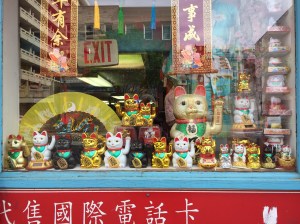
Good Luck Cats fill a window near Chinatown, Washington D.C. April 2019

I googled “don’t miss sights Tokyo” and when the list appeared, I skimmed it for a place I’d never been. One caught my eye—Gotokuji—the home of the lucky cat. Some of the reviews said, “Don’t bother—boring and hard to get to”, but others said, “If you love cats, you should go.” I decided to go.

I worked out the route with the help of Google maps: from Shinagawa Station on the Yamamoto line to Shinjuku and there change to Odakyu line to Gotokuji Station, then 15 minute walk to the temple. It sounded like a perfect opportunity to try my place-finding skills in the Tokyo suburbs.

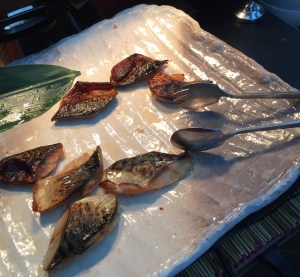
mackerel

After a breakfast of ramen noodles, miso, and a taste of mackerel, among other things, I set out from our hotel. The morning was very hot and humid, and within minutes, I was dripping sweat as I walked to Shinagawa station. 

I caught our accustomed Yamamoto line train to Shinjuku. We’d done this several times already—to go to Shibuya to do the Scramble, to the Kinokuniya bookstore in Shinjuku, and our very first outing, to Shinjuku Gyo-en National Garden. We’d had some challenges finding the garden once we got out of the station that first day, but at this point about a week into our stay, I felt confident. 

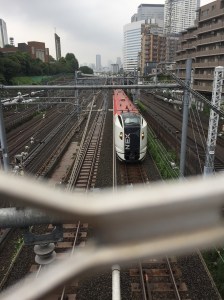
Trains running past our hotel in Shinagawa

Everything was going smoothly until I went looking for the Odakyu line. I found myself in another part of the station able to go no further since I’d put my ticket in the entrance machine and it believed my journey was done. Does this mean I have to go out of the station?  I was in complete confusion until I spotted ticket vending for the Odakyu line, where I was able to buy a ticket for Gotokuji, and realized, yes, I had to go out of the station to re-enter for the Odakyu line. 

Going away from Tokyo at late morning, the train was nearly empty.  Arriving at Gotokuji station—just a platform—I headed down some stairs and outside. Now what? I did not see a sign to the temple so I set out in the direction I thought I should go, but the path seemed to go only under the tracks. 

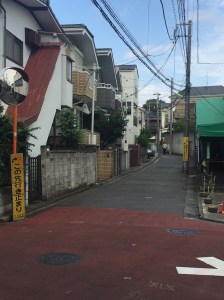
Where now? I headed back toward the station to get my bearings and start again. Without Wi-Fi, I’d been avoiding Google maps, but now, rather than wasting more time, I pulled out my phone, oriented myself, and set out again—only to find that I’d been going in the right direction after all. A short walk to the right under the tracks and straight on from there until I came to a little neighborhood, turn right, then straight down a narrow street lined with little houses. Some appeared to be multi-family, some single family with the tiniest yards. Every home had plants, shrubs, flowers, bicycles propped by gates, stone walls. 

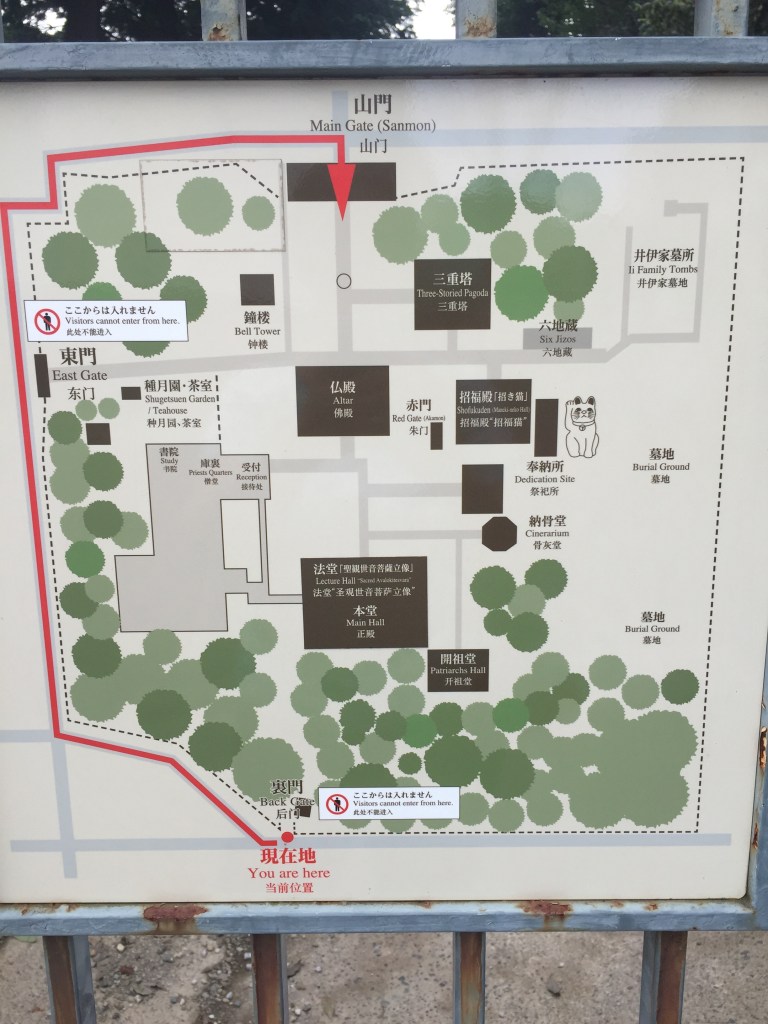
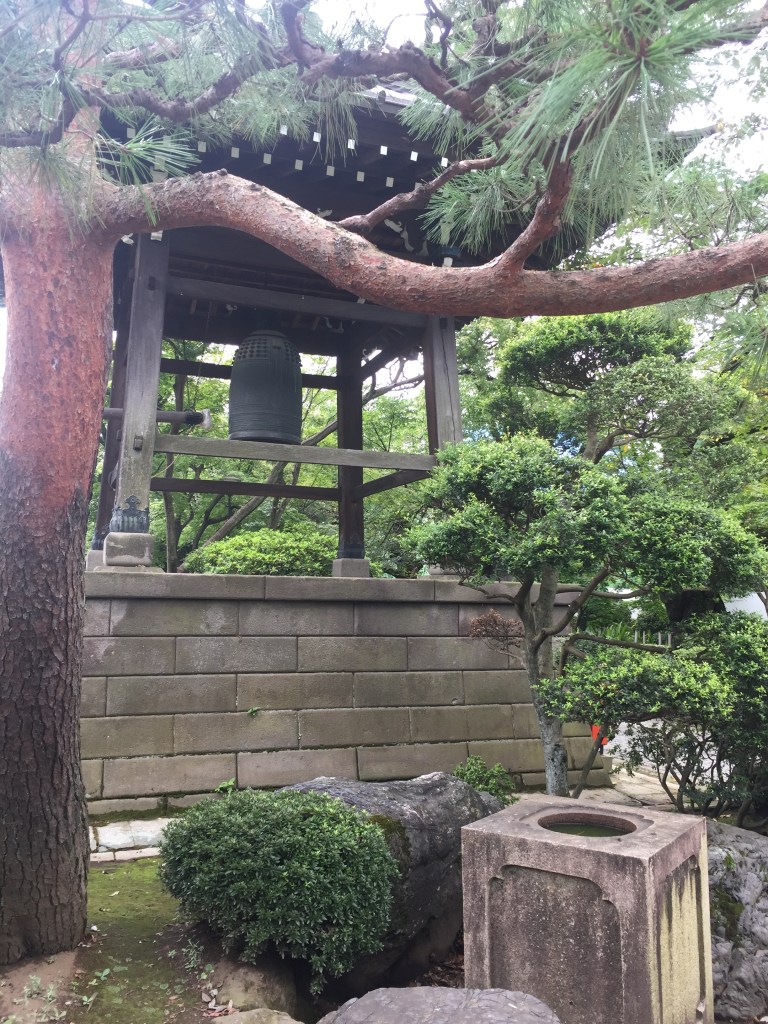
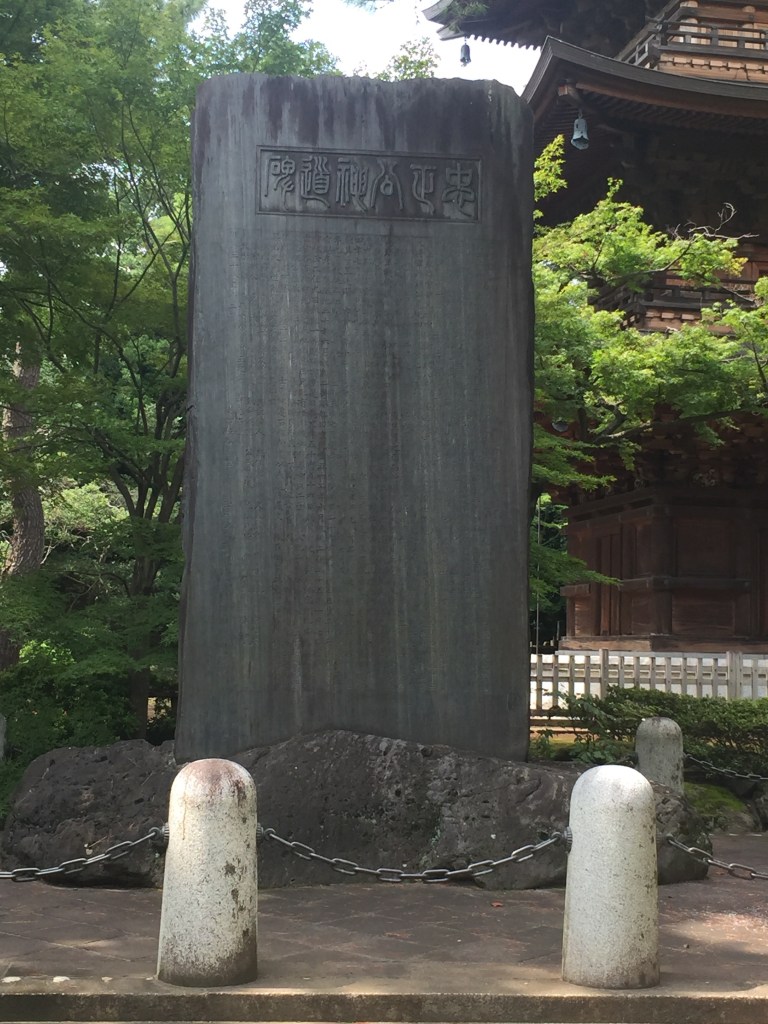
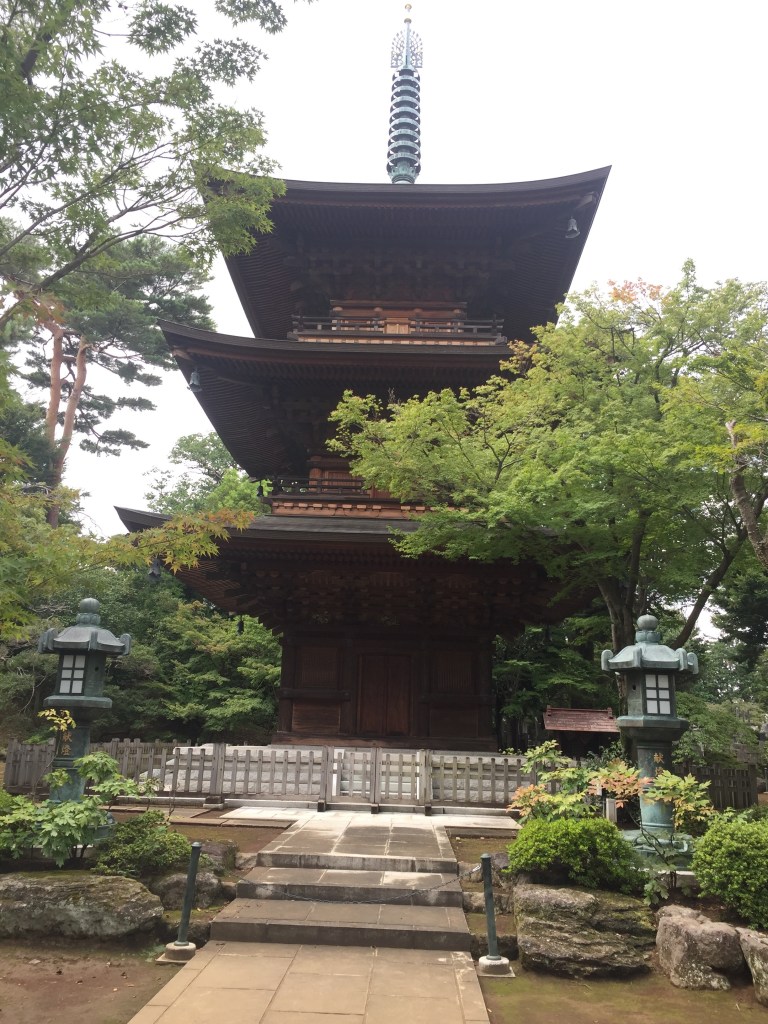
Finally I came to a high wall with a gate and a sign advising me—in English—this is the back of the temple, walk to the left and go to the front. Around another corner, and now before me, the big gate—the main entrance. I walked along a path shaded with trees, passing a 3-tiered pagoda, a tall monument of slate covered in Japanese characters, the temple bell. 

In front of the temple itself, an urn of sand and incense was set in the middle of the walkway.  The lighter wouldn’t light for me, so I waved the smoke hanging in the air above the urn into my face. 

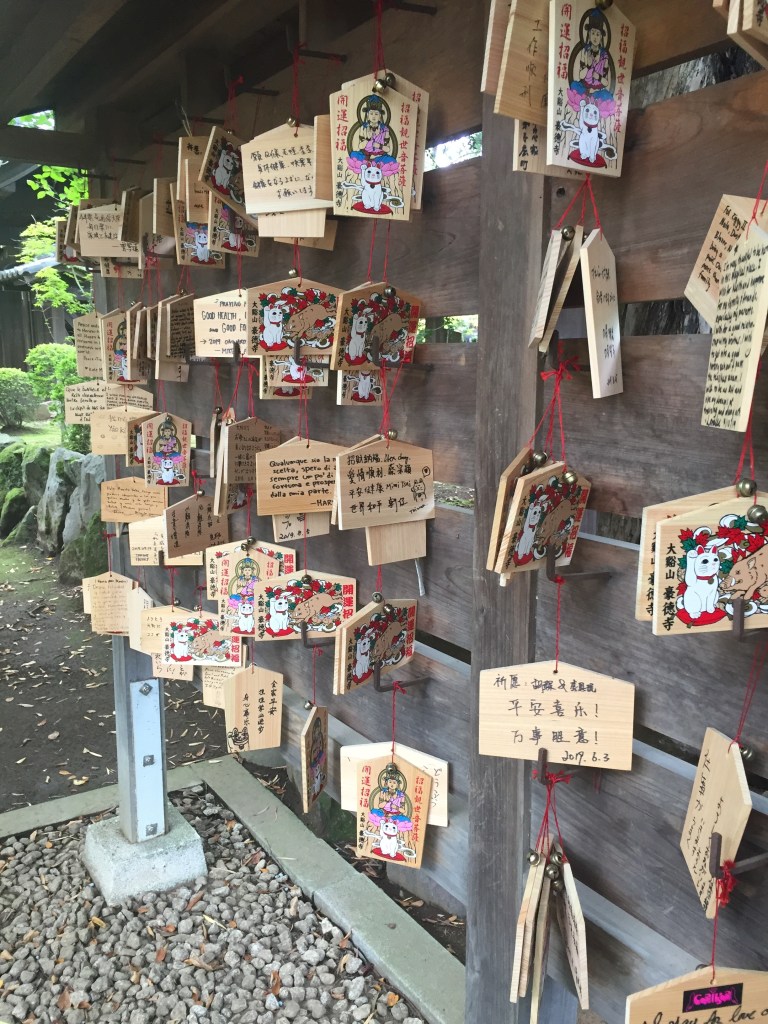
I wandered from building to building. The dark wood and beige stucco of the buildings spoke of the antiquity of the place, inviting me to linger. A few people were heading down a path, and sensing they knew where they were going, I followed along. On my right, a board displayed wooden cards, some written in English, most in Japanese, with prayers and requests for wishes to be granted. Each one carried a picture of the famous cat with paw raised. 

A little further on, I find what I’ve come for. So many cats, from the size of an acorn to very large ones, perhaps a foot tall, all exactly the same. Each representing someone’s wish, granted or hoped for. Some have been there a very long time, now dusted with green algae from the humidity, while others are bright white and new. They cluster around a lordly relaxing bas-relief Buddha who serenely oversees them.
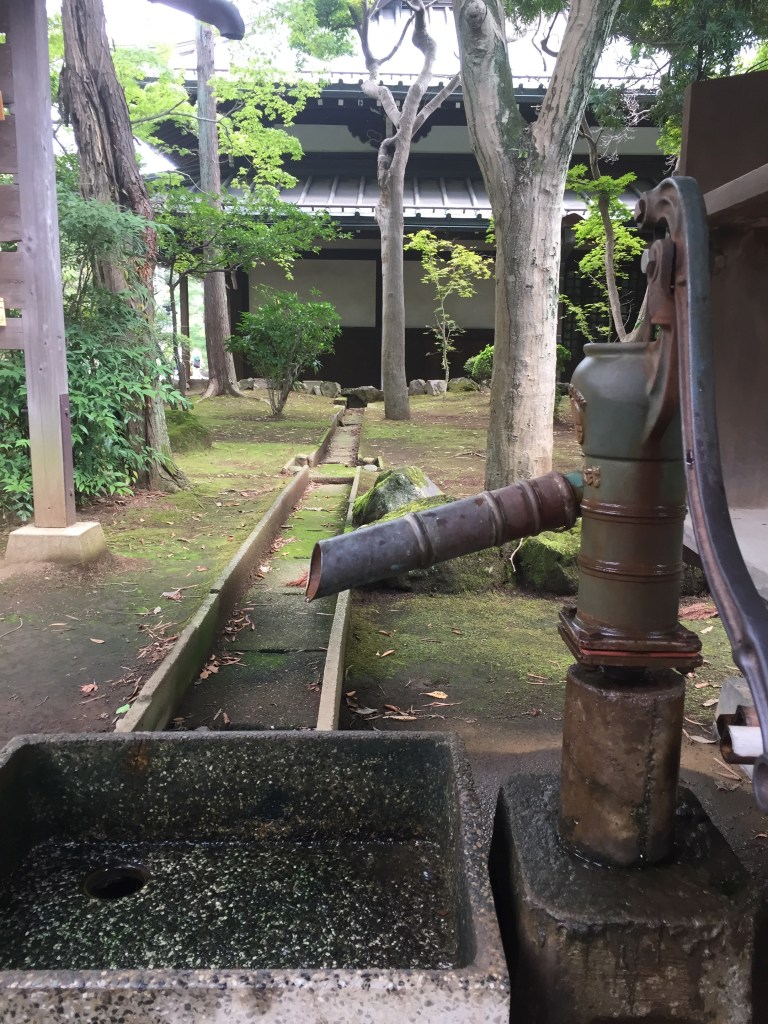
The temple is small; only a few buildings can be entered. Near the main building, a water pump can be worked to send water into a channel; like others, I try pumping and watch the trickle into the channel. In front of the temple building near the cats, people—smiling couples, elders, families—approach, bow, clap hands, pray briefly, bow, pull the bell cord to make it chime, and then wander off.  I do the same, making my wish for health and happiness for my family.

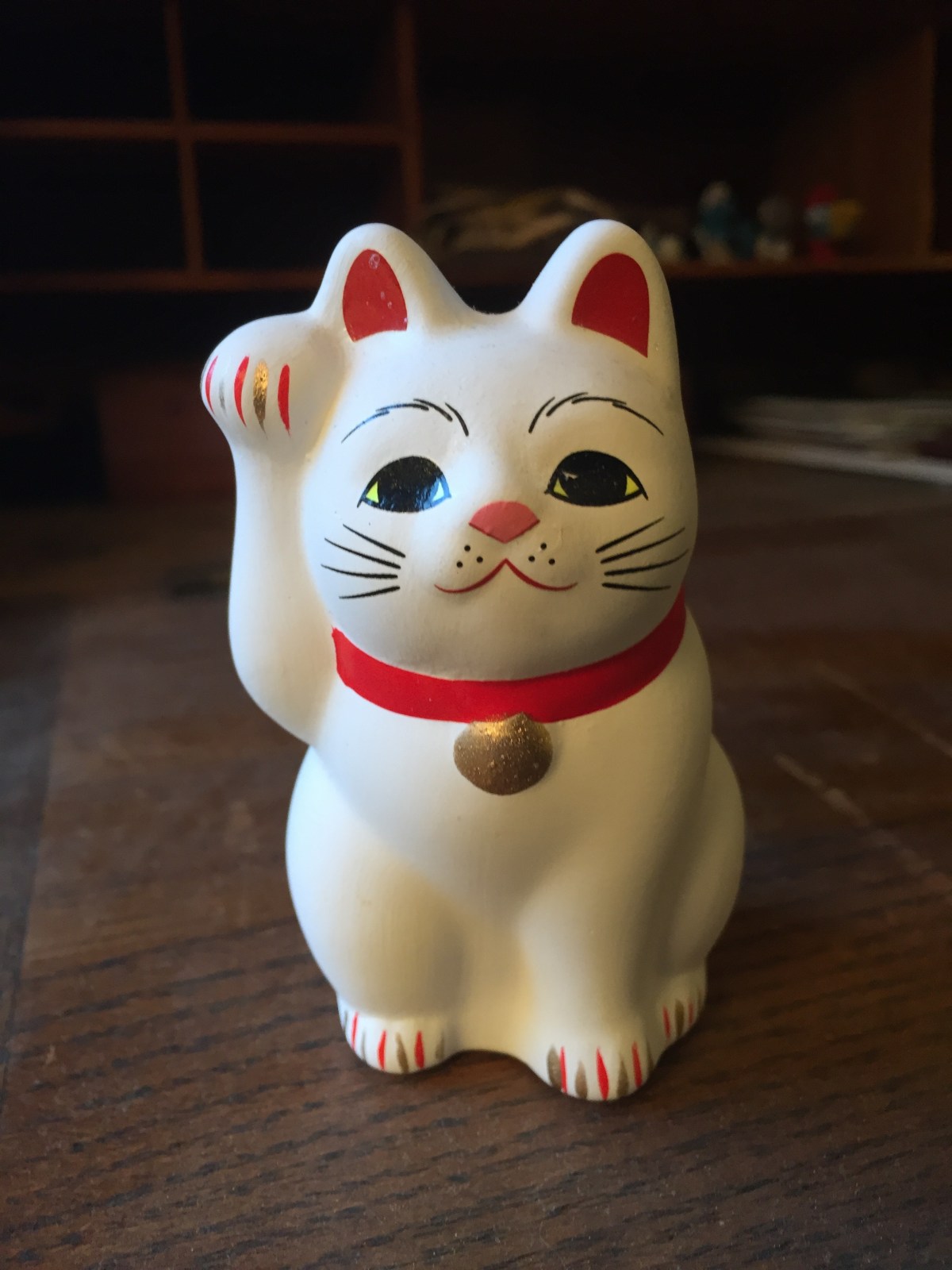
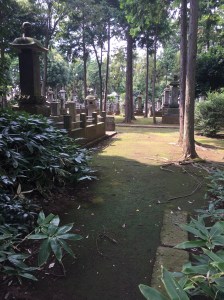
Walking further, I come upon the cemetery, where I wander around looking at the stones, and then nearby, come to the little shop where you can buy a beckoning cat to place at the Dedication Site. I bought cats to bring home to my family, and the smiling lady seemed so happy that I was there as she pressed into my hand an English copy of the beckoning cat’s story. …

A long time ago, the temple was nothing more than a shabby hut where a monk lived on alms and little else. He had a cat he loved as his own child, and one day, he said to the cat, “If you are grateful to me, bring some fortune to the temple.” A long time later, in the summer, a group of Samurai warriors came by. They said, “We were about to pass your gate, but there was a cat crouching and suddenly it lifted its paw and started waving at us, inviting us to rest.” So the monk brought them tea and urged them to relax. Suddenly a thunderstorm sent pouring rain and lightning, forcing them to remain with the monk, who passed the time by preaching to them about the Buddha.  The Samurai, so impressed, told the monk that he was king of a prefecture and because of the cat’s waving, he was able to hear this message, saying “This must be Buddha’s will.” After he returned home, the Samurai donated huge rice fields and croplands to the temple. Because of the cat, fortune came to the temple, which is now called the cat temple. The statue of the cat was established to help people remember the story, and now everybody knows it as a symbol of household serenity, business prosperity, and fulfillment of wishes.

Back at the Gotokuji Station…how did I miss this guy?

Finding the Home of the Good Luck Cat

With almost a year of Pandemic behind us and unable to travel, I dust off memories of our last big trip, to Japan, in August 2019…

We were in Tokyo, and one day, my original plan was to go to Asakusa for the day while my husband was in meetings. I’d been there with him on a previous trip, and I knew I could easily spend hours and hours there among the temples. But dinner plans settled the night before meant that today, I needed to find a simpler option.

Good Luck Cats fill a window near Chinatown, Washington D.C. April 2019

I googled “don’t miss sights Tokyo” and when the list appeared, I skimmed it for a place I’d never been. One caught my eye—Gotokuji—the home of the lucky cat. Some of the reviews said, “Don’t bother—boring and hard to get to”, but others said, “If you love cats, you should go.” I decided to go.

I worked out the route with the help of Google maps: from Shinagawa Station on the Yamamoto line to Shinjuku and there change to Odakyu line to Gotokuji Station, then 15 minute walk to the temple. It sounded like a perfect opportunity to try my place-finding skills in the Tokyo suburbs.

mackerel

After a breakfast of ramen noodles, miso, and a taste of mackerel, among other things, I set out from our hotel. The morning was very hot and humid, and within minutes, I was dripping sweat as I walked to Shinagawa station. 

I caught our accustomed Yamamoto line train to Shinjuku. We’d done this several times already—to go to Shibuya to do the Scramble, to the Kinokuniya bookstore in Shinjuku, and our very first outing, to Shinjuku Gyo-en National Garden. We’d had some challenges finding the garden once we got out of the station that first day, but at this point about a week into our stay, I felt confident. 

Trains running past our hotel in Shinagawa

Everything was going smoothly until I went looking for the Odakyu line. I found myself in another part of the station able to go no further since I’d put my ticket in the entrance machine and it believed my journey was done. Does this mean I have to go out of the station?  I was in complete confusion until I spotted ticket vending for the Odakyu line, where I was able to buy a ticket for Gotokuji, and realized, yes, I had to go out of the station to re-enter for the Odakyu line. 

Going away from Tokyo at late morning, the train was nearly empty.  Arriving at Gotokuji station—just a platform—I headed down some stairs and outside. Now what? I did not see a sign to the temple so I set out in the direction I thought I should go, but the path seemed to go only under the tracks. 

Where now? I headed back toward the station to get my bearings and start again. Without Wi-Fi, I’d been avoiding Google maps, but now, rather than wasting more time, I pulled out my phone, oriented myself, and set out again—only to find that I’d been going in the right direction after all. A short walk to the right under the tracks and straight on from there until I came to a little neighborhood, turn right, then straight down a narrow street lined with little houses. Some appeared to be multi-family, some single family with the tiniest yards. Every home had plants, shrubs, flowers, bicycles propped by gates, stone walls. 

Finally I came to a high wall with a gate and a sign advising me—in English—this is the back of the temple, walk to the left and go to the front. Around another corner, and now before me, the big gate—the main entrance. I walked along a path shaded with trees, passing a 3-tiered pagoda, a tall monument of slate covered in Japanese characters, the temple bell. 

In front of the temple itself, an urn of sand and incense was set in the middle of the walkway.  The lighter wouldn’t light for me, so I waved the smoke hanging in the air above the urn into my face. 

I wandered from building to building. The dark wood and beige stucco of the buildings spoke of the antiquity of the place, inviting me to linger. A few people were heading down a path, and sensing they knew where they were going, I followed along. On my right, a board displayed wooden cards, some written in English, most in Japanese, with prayers and requests for wishes to be granted. Each one carried a picture of the famous cat with paw raised. 

A little further on, I find what I’ve come for. So many cats, from the size of an acorn to very large ones, perhaps a foot tall, all exactly the same. Each representing someone’s wish, granted or hoped for. Some have been there a very long time, now dusted with green algae from the humidity, while others are bright white and new. They cluster around a lordly relaxing bas-relief Buddha who serenely oversees them.
The temple is small; only a few buildings can be entered. Near the main building, a water pump can be worked to send water into a channel; like others, I try pumping and watch the trickle into the channel. In front of the temple building near the cats, people—smiling couples, elders, families—approach, bow, clap hands, pray briefly, bow, pull the bell cord to make it chime, and then wander off.  I do the same, making my wish for health and happiness for my family.
Walking further, I come upon the cemetery, where I wander around looking at the stones, and then nearby, come to the little shop where you can buy a beckoning cat to place at the Dedication Site. I bought cats to bring home to my family, and the smiling lady seemed so happy that I was there as she pressed into my hand an English copy of the beckoning cat’s story. …

A long time ago, the temple was nothing more than a shabby hut where a monk lived on alms and little else. He had a cat he loved as his own child, and one day, he said to the cat, “If you are grateful to me, bring some fortune to the temple.” A long time later, in the summer, a group of Samurai warriors came by. They said, “We were about to pass your gate, but there was a cat crouching and suddenly it lifted its paw and started waving at us, inviting us to rest.” So the monk brought them tea and urged them to relax. Suddenly a thunderstorm sent pouring rain and lightning, forcing them to remain with the monk, who passed the time by preaching to them about the Buddha.  The Samurai, so impressed, told the monk that he was king of a prefecture and because of the cat’s waving, he was able to hear this message, saying “This must be Buddha’s will.” After he returned home, the Samurai donated huge rice fields and croplands to the temple. Because of the cat, fortune came to the temple, which is now called the cat temple. The statue of the cat was established to help people remember the story, and now everybody knows it as a symbol of household serenity, business prosperity, and fulfillment of wishes.

Back at the Gotokuji Station…how did I miss this guy?

At last, a new post

I have not posted here since May.

As April closed, I was focused on all that Covid-19 was stealing from us—visits with family, travel, especially the loss of a trip to London for a Within Temptation concert. I was frustrated with the new complexity of ordinary things like grocery shopping. Nothing was simple any more.

Normally a restless person, always busy, working, running errands, avoiding sitting still, the “new normal” meant I could no longer just get up and go out if I wanted or needed to.

I began working from home in March, and we settled into a routine. That really describes it—routine. Every day became the same—only the words coming out of the talking heads on TV changed from day to day, and after awhile, even they weren’t changing much.

My natural bent is to intellectualize things, and, looking back through my notebooks, I see I was doing just that—trolling the internet to find information so that it would all make sense. I searched out fatality statistics for the flu, for instance, and discovered that the CDC has only provided estimates of flu prevalence and deaths. I needed to contextualize what I was seeing on TV about hospitals over-flowing with patients in NYC; when I drove past our nearby hospital, the traffic around it seemed the same, no long lines of people waiting to get in and even a few empty parking spaces—how could it all be true?

I knew no one who’d become sick. I knew no one who’d been quarantined as possibly sick. Looking at the numbers, with a population of 330 million, and cases only numbering in the tens of thousands, it was clear that most people didn’t know anyone who’d been sick. This increased the unreality of it all.

Then on May 9, I got one of those phone calls.  Someone close to me and about my age was hospitalized with Covid-19. In that moment, I felt I had been pitched into the ocean amidst the Perfect Storm. This person was sick and frightened and I could do nothing to help. Phone calls felt so inadequate as the quavering voice on the other end said, “I’m going to die…” 

The next day, I wrote in my notebook, “Suddenly everything I’ve been doing seems frivolous and silly…before, I was in a bubble. We have been doing what we’re supposed to do—stay home, wear a mask at the grocery, and we have stayed well. And it has induced this illusory sense of well-being, that I am protected. But I am not.”

Suddenly, Covid-19 was real. Not only did I now know someone who was seriously ill with it, but I also received the reality—that it could have been me in the hospital.

Since that day, writing has felt impossible.

I tried working on a few posts in my notebooks, but nothing worked. Nothing clicked. Nothing mattered. I’d read a draft the next day only to pronounce it “not compelling—who would care?” Every time I tried to write, I came up empty.

Despite lockdowns and quarantines, events on the national scene continued to tumble. Increasing case numbers, increasing fatalities, George Floyd, protests, violence, endless political ranting, more violence, more cases, states opening, more lockdowns and protests and violence.

Through it all, writing anything began to feel like a pointless exercise. My efforts to write led me down innumerable rabbit holes, petering out into unfocused drivel. I kept up my daily pages, but they devolved into insignificant chronology and description—what I had for dinner, what my cat was doing, and a lot of “I don’t know what to write” over and over. Then, sometime in the summer, I stopped writing altogether.

The other night, plagued by returning insomnia and trying to avoid that problematic blue light, I opened Natalie Goldberg’s book, Wild Mind. This is where I landed:

“The only failure in writing is when you stop doing it. Then you fail yourself. You affirm your resistance. Don’t do that. Let the outside world scream at you. Create an inner world of determination…”

And here I am today, creating this post. Does this mean I’ve emerged from my paralyzing bout of writer’s block? I doubt it heals so quickly. But maybe I’ve finally found a way into that inner world of determination.

Postscript. 

Yet another tumultuous event happened yesterday, one that strikes close to my heart—the passing of Ruth Bader Ginsburg. On a trip to the Supreme Court with my law school class in 2007, we walked past her office, her door standing wide open. A couple of us lingered there. I craned my neck to see inside, to glimpse her if at all possible. But all I could see was a desk and empty chair. Even so, I felt close to greatness in that moment.

Covid-19 Notepad – Day 49 What we risk losing

The media has been much concerned of late with the idea of re-opening the economy, as states begin to dial back their stay-at-home orders and lockdowns. We were told these would “flatten the curve” and protect the healthcare system from a fatal crash. We have hunkered down to slow the spread of the virus. The deaths—of friends, acquaintances, loved ones, the bodies bagged and stacked in makeshift morgues—have terrified us, motivated us to stay in, stay home. 

Now (though we are surely not out of the woods yet), we begin to contemplate a new normal, where restaurants are half full, crowded bars are a distant memory, flight attendants wear masks, and we take a number to enter grocery stores. BBC News just ran a story about travel in this new world, complete with an airport disinfectant scenario straight out of Doctor Who

As we hunkered down, bans on large gatherings were among the first social distancing strategies put in place. Now it’s been suggested that such gatherings may not be allowed this year. Suppose, for the sake of argument, the bans on gatherings of 10, or 100, people remain in place for a year, two years, or longer. As we shrink our worlds to avoid the risk of infection, what becomes of concerts, performances, readings and so many other events, and the artists and artist communities that these support?

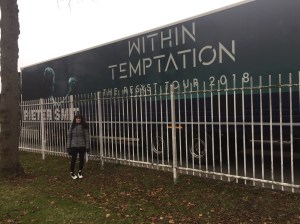
There was a time when this would have mattered less to me. I wasn’t going out to events much. But that trek to Groningen, Netherlands, to my first live rock concert ever, drastically changed my perspective. We were welcomed into a community—the metal community—where we stood shoulder to shoulder, hands raised, utterly carefree and full of life, singing the songs together as though we were singing hymns in church. What becomes of this community if we can no longer gather?

Large gatherings like this, whether 20 people for a poetry reading or 20,000 for a heavy metal concert, are intrinsic to every arts community.

If we have learned nothing else from our national experiment with Zoom meetings, it is that in-person is just better, whether it’s a meeting with colleagues, a trip to the ballgame or a concert.  Relegated to the camera’s view, we lose a powerful world of nuance and non-verbal cues, of closeness and camaraderie. But perhaps especially for art, it is that personal, real-time experience shared with others of like mind that cements our relationships and unites us into community.

While community brings people together, it also serves a another purpose. Communities sustain the artists around which they form, and the music community is no different. Indeed, artists and their art-making have generated vibrant communities around the world, helping to reinvigorate cities everywhere and making arts a vital economic engine that can help ensure the continuation of independent artists making art for the joy of making art. 

If we lose large gatherings, we risk losing the arts. The sustenance these large gatherings provide to artists—emotional, professional, financial—can vanish if performance venues can’t survive the new normal.

Without a question, even in a strong economy, arts are a tough way to make a living. A lot of parents, despite buying all those music and dance lessons, have pushed kids away from careers in the arts, telling their budding photographers and dancers, “You won’t be able to support yourself.”

This economic reality is a fact of the music world, where touring is a way of life for bands, who depend on tours to generate income. For heavy metal, historically, this has been especially true, since metal has tended not to get the radio play enjoyed by other musical genres  (a topic of its own, outside the scope of this post). Few bands have the stamina and sustained creativity, to reach that elite world of musical nirvana where significant money is to be made. Before the pandemic had even started to unhinge our world view, Kobra Paige, of Kobra and the Lotus, talked about the economic realities she and her band face.

For our part as fans, we stand to lose a kind of sustenance too. We will lose the exhilarating experience of live concerts. I went so long without them, but now, reawakened, I crave them. I think about the concerts I’ve been to in the last year, that excitement, that feeling of being a part of this big, crazy family. We fed on the bands’ energy, just as the bands fed off ours to keep them going, night after night.

Vaccines and antibody tests already in development, contact-tracing tools like apps, and other public health strategies, if they work, might permit a return to large gatherings. Vaccines are undergoing trials in several countries. Apps are in development that will allow discovery of every person who stood within 2 feet of you; China has a version, UK is about to unveil one. In the US, approaches like these will encounter significant roadblocks due, for example, to our willingness to tolerate distrust in science, or to our laser focus on individual rights to privacy at the expense of the public good. From another perspective, the fear is that these strategies would “coerce” people into trying to catch the disease.

If we want to return to even a semblance of normalcy, we need to weigh our responses to public health tools and strategies with our common good in mind. We need to think about the impact of our personal decisions on others and on the communities we care about. We can no longer think solely of ourselves and our individual happiness. We must understand, now more than ever, that our happiness and well-being are tied directly to the happiness and well-being of others.

What do you think? Do large gatherings matter?

Remembering Kathmandu, Nepal, 2015, before the Earthquake

Kathmandu, Nepal, is a mystical place, one I never imagined I would visit. But in January 2015, when my husband began his term as president of IEEE, he was invited to attend some meetings there, and I was invited to join him. Then, three months after our visit, on April 25, the earthquake struck, centered about 50 miles from Kathmandu, killing 9,000 people and destroying innumerable structures in and around Kathmandu. Aftershocks continued throughout the week.

This is one of the ways travel changes us. When the earthquake and tsunami struck Japan in 2011, when Typhoon Haiyan ravaged the Philippines in 2013, I was saddened to learn about them, but they did not cut to the core as the 2015 Nepali earthquake did–I had not yet visited these places. The Nepali earthquake left me sad for days.

When you travel to a country, meet the people, look in their eyes, share a meal with them–it changes you and your perception of them. You learn they are just like you, wanting to live their lives in peace and raise their families. And when disaster strikes, they hurt, and now–since they have become in some sense “real”–you feel their pain in a deeper, more real way.

And so, remembering the earthquake this week, five years later, I’m remembering Nepal.

Approaching Kathmandu

Our trip to Nepal began with a brief stop in Mumbai; meeting had been added to my husband’s itinerary. At dinner, I met someone who had just come from Kathmandu. Having traveled little at that point and accustomed to cities like New York and London, I innocently asked him, “Is it walkable?”  He smiled and answered, “You could say that.” 

Hotel Soaltee, Kathmandu

Arriving in Kathmandu, a taxi collected us for the trip to the hotel. I watched Kathmandu rattle by.  No multi-lane highway here, just roads congested with vehicles–picture your favorite bumper-to-bumper traffic jam, but it’s all small cars (no trucks at all, pick-up or otherwise), and it’s moving steadily (more or less) at about 30 miles an hour. And instead of pavement, it’s a dirt road, rutted and bumpy. Add to this, a hundred motorcycles, all weaving in among the cars, zipping in and out, many with two riders, often with two adults and a child between.  By the way, they’re all wearing helmets.  That’s Kathmandu.

The streets are lined with buildings, mostly brick, often brightly colored, and in the market streets, little shops are cut like slivers into the buildings, their fronts completely open to the chaotic street. In one street you might see bolts of cloth stacked in the doorway and lining the walls, bursting with kaleidoscopic color; next door stainless steel ladles and pots hang glittering in the sun. Another shop offers scales, hanging  in a neat row; next door to this, a pile of chickens, heads lolling, stacked in a pyramid on a plain wooden table; and next door to this, half-mannequins dressed in jeans, and fleece jackets on hangers.  

The taxi bumps and grinds its way along the street, dodging motorcycles, trying to avoid holes in the road and pedestrians, some in traditional clothes, walking obliviously with a load of goods towering high on their heads. Roadside shrines are everywhere…niches with statues of deities or small structures for deities to hide in; sometimes they are just small statues next to a building or right by the road. 

The next morning, some of us set out on a tour of Kathmandu, guided by a young engineering student. We began at the Budhanilkantha Temple, where the Hindu deity Lord Vishnu sleeps on a bed of serpents in a pool of water. It’s said that a farmer was plowing a field when he discovered this massive stone image of Vishnu buried in the soil.  We received blessings from a holy man who marked our foreheads, and then we put our shoes on a rack and got in line to visit the Lord Vishnu.  In front of Vishnu, people placed all types of offerings, but mostly rupees, and every so often, the attendant would scoop up armfuls of rupees and put them in an offering box

Our next stop was Durbar Square, the former palace of the Nepali royal family and an area of many temples, where we walked around. You could easily spend hours here visiting all the temples and shrines.  The buildings are all hundreds of years old.  One of the holiest is  Kumari Ghar, where the living goddess Kumari lives.  Every year a young girl, aged maybe 10 or 11, is selected to become Kumari, and she lives in this temple.  She does not go to school, and only occasionally on holy days goes out to bestow blessings.  When her time as Kumari is over, we were told, the girl goes back to normal life—how does one go back to “normal life” after a year of being revered and worshipped as a living goddess? We glimpsed her as she looked out over the interior courtyard.

Durbar Square

In the evening, we were to go to dinner at a restaurant called the Anatolia.  In the hotel drive, we boarded a large coach bus and set out, but part way there, the bus stopped.   We had to get off and board another smaller bus because our coach bus couldn’t fit through the narrow street. The smaller bus drove awhile then stopped and we walked the rest of the way.  Luckily we didn’t have too far to walk in the dark—there are no streetlights, and the shops along the way were generally illuminated by one small light bulb.

Arriving at what looked to be a shop, we were led inside and up the stairs to the second floor restaurant. Inside, the large room had bright pink walls hung with paintings, and rows of tables, set up to accommodate our group.  Along the street-side wall, other diners were trying to enjoy their meals as we all trooped in. Apparently the restaurant did not understand how many people were coming, because talk making its way around the room hinted that they did not have enough food for all of us!  But no one was concerned and some of our group went shopping down on the street while we waited for our meal.

Our whirlwind tour of Kathmandu included visits to Bouddhanath Stupa and an aerial visit to Mount Everest before heading back to London and ordinary life.

Covid-19 Notepad: Musings on Day 26

Today is day 26 of our self-isolation.

In Massachusetts, the number of coronavirus cases as of this afternoon at 4 pm is 26,867, up from 20,974 on Friday—an increase of almost 6,000 cases just over the weekend. In the same time period, total deaths went from 599 on Friday, to 844 today.  Governor Baker tells us that the peak is coming in the next ten days, but probably around April 20th. The numbers will get worse.

Following these developments over the weekend made me seek context. In some quarters, the fuss continues that this is just another kind of flu, and for awhile, I was harboring similar thoughts. So I went looking for some facts. It turns out that the CDC does not track actual flu cases. When you look into this, you find only estimates—no hard data. (I’m not a researcher, so the numbers may be out there; please share if you find them). 

But stats for deaths generally are available.  On any given day in New York City—normally—about 145 people, plus or minus a few, will die of various causes—heart attack, cancer, accident, violence. On the day I was looking at this, I found that 518 New York City people had died of Covid-19 alone! And a friend quickly pointed out after I posted this on Facebook that the one-day Covid-19 death toll had soon after hit 779.

This is not the flu. These are not usual flu season numbers.

It has now been almost 2 weeks since we went to the grocery store, and as perishables and essentials dwindle, we’ve begun to think about our next excursion. We also think we’ll cover our faces. 

To that end, I dug out my collection of bandannas. (I’ve been holding onto these things for fifty years, waiting for them to come in handy.) I indulged in a little nostalgia as I laid them out and folded them, inhaling their dusty homeliness.  My mom and I collected them for family camping trips; she used to pull one around her head for the morning trek to the ladies’ room, lest anyone see her unkempt hair. (I also remembered her wearing them while she was in chemotherapy, but that wasn’t a thought I wanted to dwell on just then.)

Will I wear one of my old, mint-condition bandannas to the grocery store this week? Next month? Or will we all turn to grocery delivery services? And give up the pleasure of perusing the potatoes and zucchini in real time? Will we forego that special kind of family quality time—the shopping trip? Or will we have to provide certification of virus-freedom at the entrance to the mall?

Or, for me, worse yet—I’ve only just begun going to rock concerts, reveling in standing shoulder-to-shoulder with 500 strangers while screaming my lungs out. (My May line-up of Asking Alexandria, Five Finger Death Punch & I Prevail are all postponed until September, along with the Within Temptation & Evanescence show we were supposed to attend at London’s O2 last week.) Will we have to present shot records to get in?

CNN showed the Chinese approach to the new Covid-19 normal this weekend—an app that tracks a person’s movements and gives you a QR code indicating whether you’ve stood next to anyone with Covid-19. You show the code to be admitted to an event. So just like we hold out our phones displaying our tickets to concerts, you would show your code to be admitted. Would anyone dare get in line with anything other than a green-for-go code? A recent Supreme Court case came to mind, the 2018 Carpenter cell phone case, where the Court decided that the use of cell-site location information records was a Fourth Amendment search, requiring a warrant and probable cause. Making an app like the Chinese Covid-19 tracking app unlikely here, at least for now.

What do you think the future holds?

#MusicMonday

I was supposed to be in London today, attending a concert by Brazilian metal band Semblant. Since I’m not there and can’t do that, here’s more from the beginning of the journey…

After Groningen, I could not wait for more—music, live music, live metal music! And soon after we got home from Groningen, Within Temptation announced that its Resist Tour was coming to the U.S. When I saw they were coming to Philadelphia, New York and Boston, over the first three days of March, that settled it. 

The weekend got off to a great start. On Thursday, I am cruising through Connecticut along I-95, about halfway into the five-hour drive, mentally ticking off my packing list—now where did I put the tickets? Oh sh*t! Kristin had even texted to remind me to bring them, and I’d replied, sure, no problem, they’re right here on the fridge. And then I went off without them—needless to say, I’m in a panic. I get off the highway—naturally, no easy rest area or side street was handy, but I find a spot to get out of the way of traffic, and send Kristin a frantic message.  Within a few minutes, my very tech-savvy daughter has it all under control: “Electronic tickets—everything’s fine.”

On Friday, we leave Kristin’s place crazy early for the hour drive to Philadelphia, running through Wendy’s first for what we believe will be our last meal for a long time, and then head to the Fillmore. The GPS leads us to what looks like a vacant lot with chain-link fence and barbed wire curled around the top, under an elevated highway—this is the parking? Luckily our friend from the Facebook fan group, whom we’ve never met in person before, arrives about the same time with a carload of more friends, and she knows the drill. 

For all three shows, we have general admission tickets. We are packed onto the floor like sardines, with several hundred others. Groningen was the first time I ever experienced this. When we first get inside the venue, the crowd is thin—the die-hard fans arrive early, and the rest fill in later. All kinds of people are here, all ages, from little kids riding their parents’ shoulders to oldsters like me, most wearing band Tee-shirts, many sporting fantastical tattoos, long hair, short hair, all different color hair, from gray (dyed, on twenty-somethings—why is this trendy, I can’t help wondering) to cerise to blue (like mine). Some tiny college girls behind me are long-time fans of Within Temptation and seeing them for the first time—I will give them room, just as some of the In Flames fans moved over to give me room. One of my takeaways from the weekend was just how nice everyone is; you feel like you are  crammed in with 500 of your best friends—literally.

Smash into Pieces opens the show. First out is the drummer, completely hidden under a black cape and an illuminated mask, then joined by the others. The crowd slowly warms up—it seems this band is new to everyone else as well as me. But they lead off urging everyone to jump, and before I know it we are jumping and head-banging and every molecule in the room is vibrating. In the middle of it all, their vocalist dives into the crowd. Gasps and cheers—all I can see is his feet sticking oddly above the crowd, then vanishing. They’ve dropped him! But he clambers back onto the stage and with a wisecrack, goes on.

Next up, In Flames—the vocalist’s cheeky banter with the folks over there in the middle front, the white-haired, bearded guy with the gorgeous white guitar, the bass guitarist with his slashed jeans revealing a tattooed knee, the other guitarist with wild head-banging rocker hair and incredible biceps, and the drummer going crazy up there in back—I am grabbed by the throat and pulled into the music. If this is metal, give me more! 

When Within Temptation comes out, they are as spectacular as I remember them, and this time, I sing along on many more songs. And when it’s over, all I can say is, “Wow, we get to do it again tomorrow!”

After the show, a clutch of us huddle together in the cold rain by the stage door, hoping Sharon and the boys will come and talk to us; she’d had some trouble with her voice initially and said she had a bit of a cold. But she does come over, and the others ask for photos.  She agrees, but says, smiling, “Go home—it’s raining! Aren’t you cold?” 

Finally we make our way to my car for the drive back to Kristin’s. The rain is turning to snow, and within a few more miles, it’s snowing heavily. We will flirt with this storm the whole weekend. 

In the morning, we’re up and back in the car for the drive to New York, where we will catch the show at Playstation Theater in Times Square. We make another friend in the line at the theater. I satisfy a craving for a hot dog off a foodcart near the line. Then with our friend’s help, we secure spots at the barrier again. Some friends from Philly are here too. 

Each band pulls me into their world—the musicians deep in their music yet feeding off the crowd, the crowd feeding off them, heads banging, singing along, horns up. Red and blue light fingers explode through the haze, the floor vibrates under my feet. I never want it to end!

Between bands, the lights come up and we chat with people standing near us. In New York, In Flames had a lot fans and one guy had been a fan for over ten years, and this was his first time seeing them live. His excitement at being there was over-flowing, and caught In Flames’s vocalist, Anders Friden’s attention. Anders asked him for his phone and tried to snap a photo of the crowd but the phone locked him out. The fan was devastated. But after the set, the setlist was tossed toward us, and I caught it and gave it to him, setting off tears of joy.

With the crowd warmed up by Smash into Pieces, In Flames further incites moshing and crowd-surfing. We keep an eye out, lest crowd-surfers slide in our direction. One guy surfs 4 or 5 times, with his lime green underpants hanging out. 

After the show, we get our picture with Smash into Pieces. The drummer is still draped in black, right down to the black makeup on his (her?) hands. Kristin and our group of friends headed outside, but I lag behind for some reason, and as a result, get to chat with Anders and guitarist Chris Broderick who are hanging out by the door. “You converted me!” I tell them and fist-bump with Anders.

After dinner at the nearby Hard Rock Café, we catch the 7 train to a Marriott in Queens for the night. And then up and out to hit the road again, this time toward home—to Massachusetts.

Sunday was perfect driving weather, with plenty of sun and not a snowflake in sight, but by the time we arrive, the weather is degenerating. Our new friend from New York joins us in line at the House of Blues, directly across the street from Fenway Park.

The show is a reprise of the two prior nights. Each crowd is different, but the atmosphere is thick with enthusiasm and excitement. Afterward, we emerge from the theater to find snow falling steadily and the street blanketed. WT’s bus is standing nearby. We pace up and down, stomp our feet, and watch the snow fall. We hope the band will appear. A couple at a time, they come out of the bus and wander over to us to chat a moment, sign autographs and take pictures, before heading to the pub down the block. Finally, Sharon comes out, and she too pauses to visit with us. They have a driving day ahead of them tomorrow, and she seems relaxed. 

Tonight, with heavy snow forecast (already a few inches on the ground), my worried husband has lined up a hotel in Copley Square where we can sleep through the storm. 

What a night, what a weekend. When’s the next one?

Covid-19 Notepad: The Grocery Trip

Today, we made our first foray to the grocery store after two weeks of self-isolation. In the last two weeks, we have gone out together once for a walk in the woods near our house, and once I drove to the beach a few miles away to go running. Otherwise, the only people we’ve seen have been the talking heads on TV.  

After perhaps too much TV, I awoke this morning on edge about the excursion. It was exciting to think about just getting out of the house (such a change—I used to long a for a day to just stay home), but today, I also worried about what the store would be like, and what might happen to us because we went. 

Our store is a typical, American grocery-extravaganza, always clogged with shoppers—families, twenty-something college kids from the nearby university, couples, moms with babies and kids in tow, elders on scooters. We planned our trip for mid-day on a Wednesday, since normally, on a Wednesday afternoon the store is  deserted. 

Today, when we arrived at the shopping plaza, the parking lot was empty, except for a mob of cars huddled at the grocery store’s end of the lot. It was definitely busier than a normal Wednesday.

Inside, where you grab a cart, a girl in an apron and gloves was wiping down the carts, and she passed one to us. The little dining area where you can usually sit down for a snack from the grab-and-go was blocked, the chairs upside down on the tables. Just beyond the registers, the path to the produce—or the bakery, depending how you look at it—was as congested as ever, with people hovering around the rotisserie chickens and turkey legs, and at the counter, eyeing the cakes and donuts. 

Signs on the floor remind us to keep
our distance.

In the produce department, the crowd did not thin out as I’d expected. The aisles were busy. Some people wore masks, several wore scarves over their faces. Most were alert to the distance between us, and we nervously smiled as we tried to pass each other to get to the avocados. Signs plastered to the floor and across the meat aisle and deli counters helped us remember to keep the six-foot distance in mind.

We had a long list of items we’d been tracking over the last two weeks, for routine meals, particular recipes, or staples we always keep on hand. We were moving quickly through the store, giving wide berth to other shoppers. I am not usually phobic, and generally I enjoy grocery shopping, looking around, investigating new or interesting items. But today, midway through, a sense of foreboding began to rise in me. Just being here so long felt somehow dangerous. I need to get out of here! Our cart was full. It would cost a fortune. It’s time to go. Now.

Finally, we moved to the checkout counter. Here, unlike most days, we did not have to wait. We moved right into a checkout lane, behind a woman with just a few items in her cart. The masked man behind us hung back, easily ten feet away. No rushing to grab a divider to separate orders (in fact, there were no dividers at all). We’ve gotten used to using our own reusable bags—I have a picturesque one from our trip to Germany last summer—but today, no, the bagger said, can’t use those now.

Back at the car, we reorganized the bags into our reusable bags and filled the back of my Forester. In the car, we slathered on the hand sanitizer and drove home.

We need to order a few things online. For some reason, yeast and flour are hot commodities—has everyone begun baking their own bread? And we’ll do without a few things for awhile. And the bill was a shocker, but the pantry is fuller than it’s ever been. And we’re confident we can remain hunkered down for several weeks before we need to do this again.

Covid-19 Notepad

Or how I learned to stop worrying and love the virus…

How are you doing? We are doing OK.

Day 8 of self-isolation.

The days have settled into an easy rhythm–of coffee, meditation, work, and workouts, with healthy doses of cat-cuddling and cooking and eating. The stash in the fridge is starting to diminish as we use the produce we stuffed in there a week ago on our last grocery run. Not missing the half-hour commute to the office–time that has been transformed into writing time–writing for me, rather than for work.

The confusion and anger I felt initially has also given way. The gentle stretch of the day, with my time more under my own control seems to have reduced my anxiety. Since we are on a fixed income now, we don’t have the paycheck worries that so many others have.

I’ve reduced the amount of time I spend reading and watching news. We’ve got the tips on how best to avoid Covid-19; we’re hunkered down, staying in and away from others. I do check for the latest stats–our county now has 90 confirmed cases and Massachusetts has 2,417, as of this afternoon. However, I could not avoid reading the story reported by the Washington Post, that some hospitals are considering universal DNR (do not resuscitate) orders for coronavirus patients, a painful and alarming development for all, but especially for those in our age group. Media just increases my anxieties.

But that’s where exercise comes in. This afternoon, I got out for a run at the beach, where the air was dazzling and the waves sparkled over the sand and cobbles.

Stay well, stay tuned.

Groningen, Where Everything Changed…

Forget the coronavirus for a few minutes, and come back with me…

I grew up in the Sixties, saw The Beatles on the Ed Sullivan Show, the night before my 10thbirthday, along with 73 million other people. I spent most of my early teenage years with my little transistor radio glued to my ear (it was about the size of my smart phone, but a little thicker). The Beatles went in their direction, and I wandered away. Married in my twenties, we lived briefly in California where I listened to a progressive rock radio station that introduced me to Elvis Costello, Patti Smith, Joan Jett, the Cars, but then we moved again, to northern Maine where the only radio station that appealed to me was public radio. I listened to classical music in the mornings every day, Morning Pro Musica with Robert J. Lurtsema. And then somewhere along the line, even that stopped.

So I was musicless until 2018. Never went to a concert of any type—well, Arthur Fiedler and the Boston Pops came to my hometown while I was in high school; Teresa Stratas, a star singer with the Metropolitan Opera also visited and my mother, desperate to hear her, took me along. And then there was Weird Al, maybe ten years ago, with my daughter. But that’s it. Nothing else. I recall sitting on the stairs in my father’s house, knowing the Monkees (or was it the Beatles? Hard to know, it was so long ago) were in Boston—but that was so far away, and when I was a kid, there was no money for such things.

Fast forward—it’s 2017, and my daughter, Kristin, is fascinated with a band—a Dutch band. The band hadn’t toured in 4 years, and she’d missed them that time, so she said, “Hey Mom, how about we go see Within Temptation? They’re touring again.” “Where?” “Europe”. This of course gave me pause, but  life had changed over the last few years: my husband and I had been traveling a lot; I’d spent a few months in the Netherlands on my own; and a milestone birthday was approaching for my daughter. After some further thought, I agreed.

What had I done? I’m going to the Netherlands to see a symphonic metal band. I don’t even know what that is. My daughter insisted we buy tickets immediately—“They will sell out fast!” A few days later, “I also snagged VIP tickets,” she told me.  Now I am not only going to a metal concert, but I am also going to meet the band. What have I done? Did I mention I was 64 years old at the time? 

With the tickets bought so far ahead, I had time to do my homework, but procrastinator that I am, it was Fall 2018 before I got some CDs and started listening. My daughter had actually played some of the band’s music on a road trip to Maine a few years earlier, so a couple of songs were actually familiar. I asked her about mosh pits—were those a thing to worry about? Not with this band, she assured me. I knew metal music only from headlines and that whole Walmart-banning-explicit-lyrics-thing that happened a while back.

November arrives, and shortly after Thanksgiving, we arrive in Groningen, Netherlands. Our hotel is next to the venue, Martini Plaza. In the evening, we scope it out, make sure we know where to show up for the VIP thing.

On concert day, we appear in the venue lobby, and wait. A small group of others, mostly from around Europe, are also there, and we chat. Most have been following Within Temptation for years, like my daughter.

Kristin in front of one of the band’s trailer trucks.

Then we enter the hall where we will first listen to sound check. The singer, Sharon den Adel, is there, soon joined by the other band members. She is dressed in jeans and a comfy jacket and leggings, and she’s tiny, and when she sings, her voice is pure, beautiful, but I understand she is not turning it all on right now, not yet. They come down from the stage, to chat and take pictures. It all feels so natural, strangely ordinary. Ruud Jolie, lead guitarist, says to me, “You’ve never been to a concert and you decide to come to Netherlands to see us as your first?” Yes, indeed!

(L to R) Mike Coolen, Ruud Jolie, Sharon den Adel, me, Stefan
Helleblad, Jeroen van Veen, Martijn Spierenburg
Our selfie, but Sharon had to click the picture!

Following a tour of the backstage area, we take up our spots on the railing in the hall, and wait. Now the waiting is hard. My old feet are feeling it (we—perhaps foolishly—had walked into Groningen in the morning, not wanting to waste a minute.) Tech people are puttering around on the stage. Someone is tuning a guitar—“Is that one of them?” I ask my daughter. “No, just a techie.” Then the lights go down. A momentary hush.

Guitars scream, the bass pounds. Ego Kill Talent takes the stage, wild and crazy, leaping about, stomping, guitars driving, lights flashing from all angles. The music surges through me, like a tsunami, pounding, vibrating my body like I’ve never felt before. I am alive! I can feel it! I have never felt so alive!

That’s me with the pink wristband (photo by Janne van der Vegt)

Again the lights go up, again we wait, but now everyone is impatient, watching watches, checking phones. At last Within Temptation takes the stage—drummer, keyboardist, guitarists, and finally, Sharon emerges, and the crowd goes wild. Her voice is perfect, and she is radiant. I am teary-eyed. I cannot believe I am here.

I am so close to the stage that I can watch Ruud’s hands on his guitar, I can tell the notes he is playing. The lights are flashing, smoke is pouring from the stage like eruptions, jet blasts, contrails spraying from the floor. The drums—oh, the drums! The pounding is going right through me. I feel the music, and when Sharon sings the lyrical bit at end of Raise Your Banner, my heart is in my throat.

I knew from that moment there is no going back to silence.

Me with Ruud Jolie after the show–around 2 am

Covid-19 Notepad

Driving home from my office the other night, I was thinking about the coronavirus situation we’d all been talking about–events cancelled right and left, meetings moved to cyberspace, kids pulled out of activities, schools closing. Panic. Everywhere. Then I heard these words:

“when the fear and panic takes a hold

look within your soul

when your sorrow drags you down below

you must take control

your strength will unfold

take control”

“Take Control”, Killswitch Engage, Atonement, 2019

The coronavirus situation makes us feel confused, anxious, angry, panicked. But this song got me thinking–panic and control are opposites.

When we feel panicked, we feel out of control. We feel we suddenly have no control over our environment. Our feeling of power–the ability to control our environment and bring about change–evaporates. When things get out of control, we panic amid the chaos.

The chaos feels very real right now. Our war with the coronavirus is guerrilla warfare. We can’t see it, and without testing, we can’t track it in our corner of the world. It feels inexorable, unavoidable.And we feel helpless, that we can’t do anything about it. I don’t know about you, but I’ve been feeling pretty panicked and out of control.

But the song reminded me that I can act to take back control. Right now, simple acts like washing hands, carefully wiping surfaces are rebel acts–acts of defiance, insurgency. toward this invisible enemy. Doing these things allows us to take back control, take it into our own hands. We stand apart from others as an act of self-protection. As we take control in these simple ways, we protect ourselves, families, communities.

These small acts of control and defiance rebuild our sense of personal power in this guerrilla war against Covid-19.

I’ve begun–I’m working from home now; we’re planning our strategic trip to the grocery store, and we will be ok.

Stay tuned. More to come.

Covid19 Notepad

Or how I learned to stop worrying and love the virus…

A few weeks ago, when I first began to pay attention to the coronavirus, now known as Covid19, I watched the expanding crisis in China, its slow beginning, first a single news story about this strange new virus that appeared probably in a market somewhere in Wuhan, I didn’t think much about it. Yet I continued to follow the stories–next a few more cases, then quarantines, and hospitals being built overnight. Wait–hospitals built in just days–what makes a country do that?

Then one day, it occurred to me, this is not going away soon. And more recently I’ve begun to feel that this virus will be the new “common cold”. This is the future, the new normal. And it brought to mind other memories from my childhood–duck and cover drills, bomb shelters, my mother hushing us because “The President is going to tell us if we’re going to war.

I wrote the above paragraph only to discover a few minutes later that the present President would also address the nation about a crisis, as Kennedy had–a new crisis–a new kind of crisis. A crisis that will test us as a country, but more importantly, it will test each of us in ways the Bay of Pigs never did.

Massachusetts today declared a state of emergency. More cases will appear tomorrow. The prestigious New Bedford Half Marathon has been cancelled. What’s next?

“When I compose a first draft I just let everything I feel and think spill out raw and chaotically on the page. I let it be a mess. I trust my instincts. I just let my ideas and feelings flow until I run out of words. It’s fine for an early draft to be a disaster area. I don’t censor myself. When I have this raw copy, I can then decide if this idea is worth putting more effort into.”

–Charles Johnson, The Way of the Writer: Reflections on the Art and Craft of Storytelling

“Often, creativity is blocked by our falling in with other people’s plans for us. We want to set aside time for our creative work, but we feel we should do something else instead. As blocked creatives, we focus not on our responsibilities to ourselves, but on our responsibilities to others. We tend to think such behavior makes us good people. It doesn’t. It makes us frustrated people.”

–Julia Cameron, The Artist’s Way: A Spiritual Path to Higher Creativity

“Shall we begin?”

So says Daenerys Targaryen as she and her team survey the map table in preparation for the siege of King’s Landing.

She says it authoritatively, less a question—far more a command. A demand. This is what she’s been working toward, planning for, suffering for. And now it’s upon her.

The launch of anything can be daunting. The idea of commitment to a plan, a cause, taking a risk, a leap of faith that a thing will work, succeed. The risk is frightening. When we begin, we put ourselves out there. We say, This is the start of something, something that matters and I am committing to it.

We all experience many beginnings—our own lives, at birth; marriage; embarking on a career. I remember clearly the day I filed papers for the nonprofit I started 8 years ago. The trepidation—the feeling of “let’s forget this—I can’t do it.” But I took the leap, I did it, and it’s been pretty satisfying.

Now I am beginning this blog. Launching myself into the ether, so to speak. Putting my words out there for anyone—or no one—to read. 

I wrote the first post weeks ago, as yet unposted. I got stuck when I decided to upload my photos to the cloud so that I could work on the blog wherever I was, another daunting act since I am no techie. I have 12,000+ photos from all over the world, and I had no idea how long the upload would take. Two weeks in, and it’s still in process, and I can’t seem to get at my pictures. I’d committed to begin, but this wall arose, stopping me. To be frustrated in this way led to “oh what the hell—give it up” thinking. 

But a new understanding emerged. That instead of a wall, this waiting is an opportunity–to prepare, to get ready. No giving in to the pre-event jitters, the pre-performance nerves. It’s time to get to the real work.

So stay tuned. We have lots to talk about.

“Things outside ourselves will always beg us to conform, but they aren’t the real challenge. They are just an excuse or an out when we can’t face that inertia inside us, that resistance and boredom that arise as soon as we make an effort toward something we deeply want.”

Natalie Goldberg, Wild Mind: Living the Writer’s Life

It’s a New Year…time to get moving!

So it’s a new year—2020—and a good time to start sharing my journey. Where will this year take me? Not really sure, but I know it will be pivotal. 

I set up this website to share my journey through books, music, the world—the things I enjoy most—but there will be other stuff along the way.

I am embracing minimalism at last, so I will be de-cluttering my house and my life. Getting rid of the detritus. Streamlining. Focusing on what is important.

And I am making my health a priority—so I will get moving and keep moving. 

Stay tuned. I expect an interesting year.

London At Last!

Leaning on the railing of London Bridge amidst throngs of people on this amazingly sunny November day, with the Thames, Tower Bridge, and HMS Belfast all arrayed before me, I could only think how good it was to be back in London, one of my favorite and most visited cities.

Fourteen years ago, when I emerged from the St. Pancras train station in London that very first time, I was filled with a sense of homecoming. Today’s vista evoked that same sense. Ever since I was old enough to know about this place, I’d been fascinated by all things British. I’d read voraciously about England, always favoring English writers. I had an English pen-pal. I studied English history when I was in college. It was not ever a matter of “if” I would visit England, but “when”. I always knew I would. In 2008, I finally arrived for what would prove to be the first of many visits. But when we last visited in 2017, I did not expect it to be 5 years before I could return. Indeed, it wasn’t supposed to be.

In November 2019, the Dutch symphonic metal band, Within Temptation, announced their Worlds Collide Tour with co-headlining American band Evanescence. When I saw London’s O2 Arena on the list of dates, I decided it was high time I introduced my daughter (she who had introduced me to Within Temptation) to this most favored city. I planned a family trip around it, inviting my Dickens-fan daughter and her husband to join us as well in April 2020, and I immediately began planning an itinerary to please all five of us.

And then, of course, you know what happened. Three Tour postponements due to the pandemic left me feeling the trip would never happen. Life got in the way further causing Megan and her husband to pull out of the still-uncertain trip. The latest reschedule put the Tour’s kickoff in November 2022. We didn’t book flights until a month out, when I finally felt reasonably confident the Tour would happen.

Even as we sat on the airplane waiting to taxi, I couldn’t ditch the foreboding that something would crop up at the last moment to prevent this trip. As I lugged my carryon along the jetway at Heathrow’s Terminal 3, I began to believe it, but, at last, standing now on London Bridge, the matter was settled–I’m back in England!

On our previous visits, getting from Heathrow to London proper meant an hour-long journey at a minimum, as we usually took the Underground, involving an hour ride into the city. However, a few weeks before our trip, I’d read about the Elizabeth Line, a new railway line recently opened by Queen Elizabeth that would eventually connect Heathrow seamlessly to Canary Wharf—but not just yet, said the article; the new line was only operating to Paddington Station, where we would have to switch to another train. When we boarded the Elizabeth Line at Heathrow, however, we learned from another passenger who used it for her regular commute that the Canary Wharf section had indeed just opened “last week”. Happy news, since we’d booked our favorite London hotel, the Marriott Canary Wharf, for its easy proximity to the O2 Arena.

One thing I always appreciate about traveling to London is that we take a night flight that gets us into Heathrow in the morning—we don’t lose a day for travel. Since I can’t sleep on airplanes, I usually hunker down with a good book or fine-tune my sightseeing plans. It also means I’m eager to get off the plane and usually find I’m running on adrenaline by the time we reach the hotel. I’ve found the best way to get acclimated to local time is to just keep running—with the fortunate result that I never have jet lag.

My plan to introduce Kristin to London got underway immediately on arrival. We stopped at the hotel long enough to drop our bags in our room (we requested an early check-in) and freshen up a bit, then it was out the door and back to the Underground where we hopped on the Jubilee Line to London Bridge Station. From there, we could clear out the last vestiges of air travel brain fog with a walk along the Thames while taking in the iconic sights.

Emerging from the tube station, we walked across London Bridge crowded with people. From here, you get a lovely view of Tower Bridge, the World War II battle cruiser HMS Belfast, the Shard and the London skyline.

View of Thames River from London Bridge, showing Tower Bridge, HMS Belfast

View looking east from London Bridge

On the north bank, we picked up the Thames Path (a national walking path following the Thames River from the Cotswolds through London toward the sea) and wandered along it for awhile before crossing back to the south bank by way of the pedestrian-only Millenium Bridge. Completed in 2000-2001, this bridge was the first new bridge to be built across the Thames in over a century.

From North Bank, looking across the Thames for a view of the pointy building known as the Shard

The Millenium Bridge deposits you near the Tate Modern, one of the world’s most popular modern art museums (so says the Blue Guide to London), and the recreated Shakespeare’s Globe Theatre.

From South Bank, looking across the Thames to the dome of St. Paul’s Cathedral

On the south bank, we picked up the Queen’s Walk (WalkLondon.com offers a self-guided sightseeing tour) and staved off hunger with roasted nuts from a Bankside vendor before continuing on. Along the way, we passed the graffitied Southbank Skate Space.

The skate space as it appeared in 2012; see the link for the story of how this space became a skate boarder’s paradise.

The Southbank Centre Winter Market was in full swing, with pop-up bars (where you could enjoy a warming hot toddy, for instance) and food (not your average street food—we saw Dutch pancakes and lobster on offer) housed in chalet-like shelters limned with holiday lights.

We could not let Kristin’s first day in London go by without a Big Ben sighting, so we crossed the Westminster Bridge with its picture-postcard view of the Houses of Parliament and the newly refurbished Elizabeth Tower housing Big Ben. “Big Ben” is actually the name of the bell inside the tower that tolls the hours accompanied by the familiar Westminster Chimes.

With the adrenaline edge fading, hunger starting to take its toll, and husband’s knees in full protest, we headed into the Westminster Underground Station to catch the Jubilee Line back to Canary Wharf, intending to find The Grapes, an historic pub that looked near to the hotel.

Best laid plans! Canary Wharf being an area of former docks and industrial sites, it turned out “you can’t get there from here” as we say in New England. We were also plagued by a lack of internet (Be sure to check your cell carrier’s international rules before traveling abroad!) and my intention to rely on Google Maps fell by the wayside.

When we finally found The Grapes (where Charles Dickens allegedly danced on the tables as a child), dinner was not to be served for another hour, and already patrons were standing about outside, beers in hand. Instead, we retraced our steps (much more easily this time) back to Canary Wharf, where we found a casual Italian place, Zizzi, at Cabot Place, one of the shopping areas at Canary Wharf.

Reinvigorated, we headed back to the hotel to land in the bar. Although we opted for the Marriott Canary Wharf for its easy access to the O2 Arena, we had an ulterior motive—this hotel’s bar has 150 gins on offer! Such a lovely way to unwind after this long day’s journey into night.

Featured photo above: The illuminated London Eye looks like a giant peace symbol when viewed from Jubilee Gardens at night.